Portuguese citizenship attracts thousands of immigrants, as a Portuguese passport opens the doors to the European Union and the whole world. In this article, we will analyse who can obtain Portuguese citizenship, how to get it and how long you have to wait, taking into account the latest legislative changes and forecasts for 2026. We will explain how citizenship differs from residence permits and permanent residence, what ways there are to obtain a Portuguese passport, and what requirements must be met. You will learn about the advantages of an EU passport, the pitfalls of the process, and typical timeframes and costs. The article will be useful for everyone planning immigration: entrepreneurs, families, students, investors, and other foreigners dreaming of living in Portugal.
Why is Portuguese citizenship so popular? The country has become one of the main hubs for relocation, especially among people from Eastern Europe. The main reason is the possibility of obtaining an EU passport relatively quickly. Previously, naturalisation took about 5 years of residence, which was one of the fastest schemes in the EU. For comparison, in neighbouring Spain you had to live 10 years to qualify for a passport, and in France – 8. Portugal looked more attractive to those who wanted to gain a strong right to live in Europe as quickly as possible.
However, at the end of 2025, important changes appeared. The Portuguese Parliament approved a new law on Portuguese citizenship, tightening the requirements for naturalisation. If the president finally approves the amendments, foreigners from non-EU countries will have to live 10 years instead of 5 in order to obtain a Portuguese passport. For citizens of EU countries and Portuguese-speaking states, the minimum period is planned to be set at 7 years. These changes are expected in 2026, although the law is still undergoing constitutional review and discussion. Thus, potential immigrants should take into account the tightening of the rules: the standard residence period is doubled, and new exams on the history and culture of Portugal may appear.
How does citizenship differ from other statuses? A residence permit allows you to live in the country temporarily, but requires renewals and does not grant all rights. Permanent residence is an indefinite status after 5 years of legal residence, but it is still not citizenship. Only a citizen of Portugal receives full status: he or she is a citizen of the European Union, can freely live and work in any EU country, participate in elections, hold public office and enjoy all social guarantees. Portuguese citizenship is especially attractive because the country recognises dual citizenship and does not require you to renounce your previous passport. For comparison, in Spain you are asked to renounce your previous citizenship upon naturalisation, which discourages many people.
Who might be interested in Portuguese citizenship? Practically everyone who is planning a long-term life in the EU. For businesspeople, a Portuguese passport gives access to the single EU market and makes it easier to travel around the world without visas. Families gain stability, quality healthcare and education for their children in Europe. Students and young professionals value the opportunity to build a career in any EU country. Immigrants from unstable regions seek safety and social guarantees, while retirees seek a mild climate and a decent old age. Unlike the status of a temporary resident, Portuguese citizenship is forever and without residence conditions: it is almost impossible to lose it, even if you leave the country for a long time. Therefore, obtaining a second passport in Portugal is seen by many as a strategic investment in the future.
Further on, we will step by step consider the advantages of a Portuguese passport, the categories of people entitled to citizenship, the ways of obtaining it and all key points of the process – from requirements and documents to timelines, costs and frequently asked questions.
Get a free consultation on the Portuguese citizenship application process
Fill in the short form below and a Mycitizenagency specialist will contact you as soon as possible
Advantages of Portuguese Citizenship
A Portuguese passport is one of the strongest in the world in terms of freedom of movement. It allows visa-free or visa-on-arrival travel to 188 countries, including most European states, the Americas, Japan, Australia, and more. As of 2025, the Portuguese passport ranked 4th in the global passport power index. For its holder, this means easy international travel and minimal bureaucracy when planning trips.
In addition to visa-free mobility, Portuguese citizenship grants the full set of rights within the European Union. Here are the key advantages enjoyed by a Portuguese citizen:
- Freedom to live and work in the EU. As an EU citizen, you can freely relocate to any of the 27 EU member states (as well as Iceland, Norway, Switzerland, and others participating in related agreements) and reside there without time limits. You can be officially employed in any EU country without additional permits. Unlike residents holding temporary permits, who may be restricted to the country of issuance, an EU passport removes these barriers.
- Quality education and healthcare. Portuguese citizens have access to free or subsidised education in public schools and universities not only in Portugal but also in many other EU countries (on the same terms as local residents). They also benefit from the EU healthcare system — you can receive medical care in any EU country using a European health insurance card, access public hospitals, insurance programmes, and more. Social benefits (allowances, insurance) fully apply to citizens.
- Social guarantees and pensions. Portuguese citizens enjoy a full range of social rights. This means you can receive an old-age pension, employment-based pensions with sufficient work history, and various social benefits (unemployment, disability, child benefits, etc.) on the same basis as other citizens. In addition, citizens hold political rights — voting in elections and referendums, and being eligible for public office. Permanent residence does not grant these rights.
- Passing citizenship to children. Another benefit is hereditary citizenship. Your children and grandchildren can obtain Portuguese citizenship by descent. If you already hold a Portuguese passport, a child born in any country will generally become a citizen automatically (you will only need to register the birth and citizenship). This ensures your descendants’ future — they too become EU citizens from birth.
- Possibility of dual citizenship. Portugal allows dual citizenship, which is crucial for many immigrants. You do not need to renounce your previous citizenship during the application or after receiving a Portuguese passport. The country recognises that a person may hold two (or more) passports, treating them as solely Portuguese within its territory. By contrast, several countries (Spain, China, India, etc.) prohibit dual citizenship, requiring applicants to give up one passport upon naturalisation.
- Other advantages of living in Portugal. Beyond legal rights, life in Portugal is attractive in itself — a mild Mediterranean climate, warm ocean, safety, a friendly atmosphere, and a relatively low cost of living by European standards. Once you obtain citizenship, you can reside in the country indefinitely as a full citizen. Portugal is known for its rich culture, excellent cuisine and wine, and a high level of personal freedom. In global quality-of-life rankings, it consistently holds strong positions (see the table below for more details).
Portugal in International Quality of Life Rankings — 2025
| Rating / Source | Portugal’s Position in 2025 | Comment |
|---|---|---|
| Global Quality of Life Index (Global Citizen Solutions) | 6th place | One of the most reputable indexes for migrants. Portugal consistently ranks in the top 10 thanks to its safety, environmental quality, freedoms, and climate. |
| Quality of Life Index — Numbeo 2025 | falls within the group of countries with “Very High Quality of Life”, approximately 18th–25th place | Numbeo does not assign strict rankings — the index is dynamically updated. Score ~168.5 — very high. |
| Global Peace Index 2025 | 4th place worldwide | One of the safest countries on the planet — a strong argument for immigration. |
| World Happiness Report 2025 | ~ 56th place | A measure of subjective well-being. Portugal traditionally ranks lower here than in “quality of life” indicators, but remains firmly in the middle of the list. |
| Human Development Index (HDI) 2025 | ~ 36th place | A very high level of human development: healthcare, education, life expectancy. |
| International Living – Global Retirement Index 2025 | 1st place | The best country in the world for retirement according to International Living. |
| Best Countries for Expats (Expat Insider, InterNations 2025) | within the top 15 | High scores for climate, friendliness, safety, and work–life balance. |
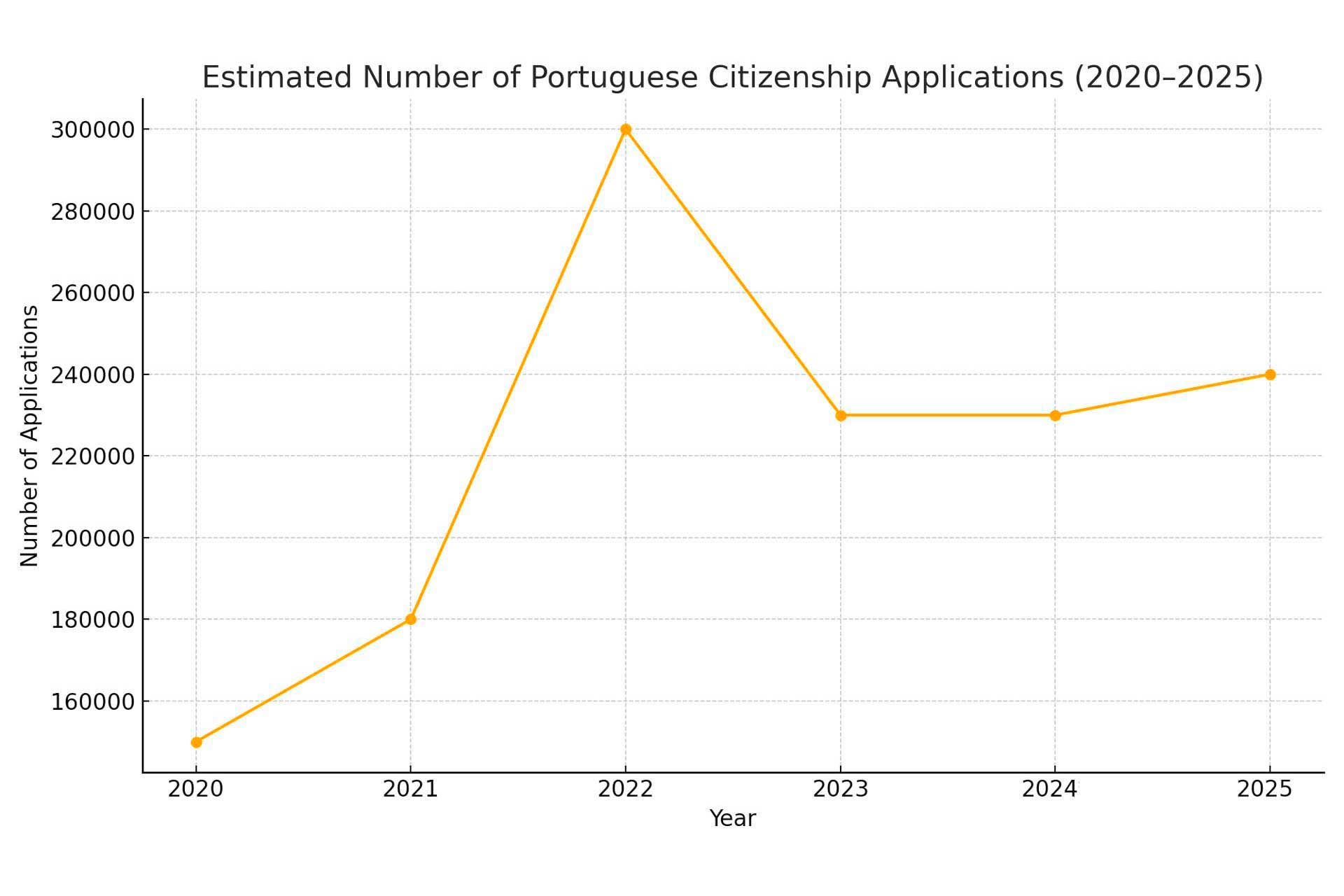
In summary, a Portuguese passport gives its holder the status of a global citizen: European citizenship with the right to live and work anywhere, protection and social benefits, as well as global mobility without visa barriers. It is no surprise that the number of naturalisation applications continues to grow — in the first four months of 2024 alone, more than 63,000 applications were submitted. Next, we will look at who is eligible to apply for Portuguese citizenship and the ways it can be obtained.
Who Can Apply for Portuguese Citizenship
Portuguese legislation provides several grounds on which a foreigner can obtain citizenship. Here are the main categories of applicants:
- Children born to Portuguese citizens. Children who have at least one parent who is a Portuguese citizen are entitled to citizenship by descent. This also applies to children born outside Portugal – they can be registered as citizens through a consulate. Moreover, in recent years even grandchildren of Portuguese citizens have been able to claim citizenship by repatriation, confirming their kinship (this provision was introduced for descendants of the Portuguese diaspora).
- Foreigners who have lived in the country for a long time (naturalisation). This is the most common route — obtaining citizenship after a certain period of legal residence. Currently, this period is 5 years; however, as noted, from 2026 it is planned to be increased to 10 years for most immigrants. Naturalisation is available to almost everyone who has met the residence requirement (has continuously lived in the country with a residence permit for the required number of years), passed the language exam, and meets other conditions (described in detail below).
- Spouses of Portuguese citizens (through marriage). If a foreigner is in an official marriage (or in a registered civil partnership) with a Portuguese citizen, they have the right to apply for citizenship after a certain period of marriage. The minimum duration of the marriage is 3 years. It is not mandatory to spend all these years physically in Portugal — the marriage can exist while the couple lives abroad. The main conditions are that the marriage must be valid and not fictitious, and the foreign spouse must demonstrate a connection with Portuguese society (for example, living together, knowledge of the Portuguese language, participation in local life). The specifics of this route are discussed in more detail in the section on ways of obtaining citizenship.
- Investors in the country’s economy. Portugal has long attracted investors with a special “Golden Visa” programme — a residence permit by investment, which can lead to citizenship after several years. However, it is not possible to buy Portuguese citizenship directly, but you can invest in the economy (for example, in real estate, business, or funds) and first obtain a residence permit, and then, after the required period, apply for a passport. Investors are valuable to the country, so the conditions for them are more lenient: they do not need to live permanently in Portugal (it is enough to spend 7 days per year in the country), and there is no language requirement at the residence-permit stage. After 5 years of participation in the programme (if all conditions are met), an investor can naturalise on general grounds. This route is described in more detail in the section on obtaining citizenship by investment.
- Children born on the territory of Portugal. Here a limited form of the right of the soil applies. A child born in Portugal to foreign parents does not automatically become a citizen, but may obtain citizenship if certain conditions are met. At present, the law requires that at the time of birth at least one parent has legally resided in the country for at least 1 year (as of 2025). In 2020, Portugal reduced this threshold to one year to encourage the integration of immigrants. However, the 2025 amendments under discussion aim to tighten this rule again: it is planned that a parent must have at least 3 years of residency before the child’s birth. Thus, giving birth in Portugal can grant a child citizenship if the family has already settled in the country for several years.
- Special cases: military service, merits, sports. The Portuguese Citizenship Law allows, in exceptional cases, citizenship to be granted to a person who has special merits before the state. This may be, for example, an outstanding scientist, artist, or athlete who has made a significant contribution and linked their life with Portugal. There are known cases where the government naturalised talented footballers or other athletes so that they could play for the national team. Naturalisation is also possible for providing important services to the country (for example, assisting in the uncovering of a dangerous criminal group — such an example is mentioned in immigration sources). In such situations, requirements may be relaxed: it may not be necessary to reside for 5 years or to pass a language exam — the decision is taken individually at a high level. Such cases are rare, but they are provided for by law. In addition, persons who voluntarily join the Portuguese armed forces (this is possible for citizens of Portuguese-speaking countries) may also be granted citizenship in an expedited manner — however, for most readers this route is not relevant.
Thus, the circle of potential applicants is broad: almost every foreign resident of Portugal can eventually become a citizen if they have no serious problems with the law. Even the absence of Portuguese roots is not an obstacle — the key factor is the desire to integrate. In the next section, we will look in detail at each way of obtaining Portuguese citizenship and the necessary steps.
Ways to Obtain Portuguese Citizenship
There are several ways to obtain a Portuguese passport, depending on your grounds. These methods partially overlap with the categories listed above.
By birth (right of soil)
As noted earlier, a child born on the territory of Portugal may acquire citizenship if the residency requirements for the parents are met. If at least one parent has been a lawful resident of the country for a sufficient period (currently 1 year, potentially 3 years in the future), the newborn is granted Portuguese citizenship. The procedure involves submitting the birth certificate and documents confirming the parents’ residency status to the civil registry. If the residency condition is not met, the child does not receive citizenship automatically — they will hold their parents’ nationality, and Portuguese citizenship can be requested later once the requirement has been fulfilled. This rule encourages immigrants to remain in the country for longer periods.
By descent (repatriation through ancestry)
This route applies when the applicant has Portuguese roots — parents, grandparents, and previously even more distant ancestors. If at least one parent or grandparent is a Portuguese citizen, the descendant has the right to citizenship by origin without any residence requirement. For example, a child born abroad to a Portuguese citizen can obtain a passport at any time (even immediately) by presenting documents proving kinship. Living in Portugal is not necessary. You must provide evidence such as birth certificates, marriage certificates, and documents confirming the ancestor’s citizenship, translated into Portuguese, and submit them to a consulate or the immigration authority. The process has also been simplified recently for grandchildren of Portuguese citizens — they are now granted eligibility as well, although they may be required to demonstrate a cultural connection (such as basic knowledge of Portuguese or proof of visiting the country). Overall, citizenship by descent is the most direct and fastest path if you have Portuguese ancestors.
A special case of repatriation is citizenship for descendants of Sephardic Jews. Since 2015 and until recently, Portugal allowed descendants of Sephardic Jews expelled in the 15th century to obtain citizenship as an act of historical justice. Many Jewish families worldwide (Turkey, Israel, the Balkans, Morocco, France, the United States, Latin America, and others) managed to prove their lineage and obtain passports. The procedure required obtaining a certificate from a Portuguese Jewish community confirming Sephardic origin of the surname, and submitting it along with standard documentation (such as criminal record certificates). Residence in Portugal was not required, making this route very popular — decisions were typically issued within 1–2 years after submission.
However, in September 2022, the law was tightened: applicants must now prove an additional connection to Portugal (such as property ownership or extended visits). In 2025, the parliament decided to close the programme entirely. The new amendments require that, in addition to proving Sephardic ancestry, the applicant must reside in Portugal for at least 3 years. Essentially, the preferential repatriation route for Sephardic Jews is being phased out. Therefore, if you were planning to rely on this ground, it is important to check the current legal status — most likely, in 2026 citizenship through the Sephardic route will no longer be available to new applicants (or will require meeting the standard residence requirements).
Naturalisation (through residence)
This is the classic route: you first immigrate to Portugal, live there for several years as a resident, integrate into the country, and then apply for citizenship. At present, the residence requirement is 5 years of legal stay. As mentioned, it is expected to increase to 10 years for non-EU nationals (this law has not yet come into force). As of 2025, however, the 5-year period still applies, which has made Portugal more attractive compared to many other countries. Continuous physical presence in the country is not required — it is sufficient to spend at least 8 months per year in Portugal. Temporary absences are allowed (up to a total of 4 months per year outside Portugal without losing residency).
Naturalisation is suitable for those who do not have any family-based “privileges”. It is the main path for most labour migrants, students, and entrepreneurs who arrive on various visas. The key is to secure legal status: obtain a residence permit, renew it on time, and meet the requirements (such as having housing, employment or income, and complying with the law). After 5 years, you may apply for citizenship, provided you have learned Portuguese at least at the basic A2 level and maintained ties with the country. The language requirement is compulsory: you must be able to communicate on everyday topics, read, and write simple texts. This is verified by passing the official CIPLE exam (Certificado Inicial de Português Língua Estrangeira) at the A2 level. Many language schools and centres in Portugal administer this exam, and the certificate must be included in your application. Certain categories may be exempt — for example, elderly applicants over 60–70 years old or applicants with specific limitations. Overall, expect to learn Portuguese — without it, you will not receive a passport.
The naturalisation process can be broken down into several stages:
- Entry and obtaining a visa. A foreigner must first enter Portugal legally. This may be a tourist Schengen visa (if you plan to enter and change your status later) or a national D-type visa (issued for long-term stays such as work, study, business, etc.). For example, many applicants start with a D7 visa (for financially independent individuals) or a D8 visa (for digital nomads). The main requirement is to enter legally.
- Obtaining a residence permit. After arrival, you must apply for a temporary residence permit. This is done through the Agency for Integration, Migration, and Asylum (AIMA, the successor of SEF). You must provide grounds for the permit: an employment contract, university admission, proof of passive income, or investments — in other words, the basis for the residence permit. Once approved, you receive a residence card. The initial permit is issued for 2 years, then renewed.
- Renewal of the residence permit. After 2 years, you must renew your residence permit. It is usually extended for another 3 years (or twice for 2 years, depending on the type of permit). During this period, you must continue to meet the conditions (e.g. if the status is work-based — you must be employed; if business-based — you must operate the business; if study-based — you must continue your studies). You cannot interrupt your residence: if you leave for an extended period and lose your permit, the naturalisation clock resets.
- Obtaining permanent residence. After 5 years of continuous residence and timely renewals, you may apply for permanent residence. It is an indefinite status: the card needs to be replaced every 5 years, but the status itself does not require ongoing proof of employment or studies. You are effectively on par with citizens in terms of residency rights (though without political rights). Many choose to obtain permanent residence as an intermediate step for stability. However, it is not mandatory for citizenship — the law allows you to apply for citizenship immediately after completing 5 years of residence, even if you have not yet received PR. The main requirement is to meet the time condition and hold a valid residence permit.
- Submitting the citizenship application. After 5 years of residence, you may gather the required documents and submit your naturalisation application to the competent authorities (either the Civil Registry Office under the Ministry of Justice — Conservatória — or a consulate if applying from abroad). The process usually takes place inside Portugal: it is recommended to apply in person at the Conservatória da Nacionalidade in your area of residence or through a multi-service citizen centre. Online submission through the electronic portal launched in 2024 is also possible, though its functionality is still limited. You can submit documents yourself or through a lawyer.
Standard documents for naturalisation include:
- A completed application form (filled out in Portuguese).
- The applicant’s birth certificate (with apostille and translation into Portuguese).
- A copy of the residence permit card (confirming your resident status).
- Proof of legal residence in Portugal for at least 5 years — this document is issued by the AIMA migration agency. It confirms you have been a resident for the required period.
- A certificate proving knowledge of Portuguese at the A2 level — usually the CIPLE certificate obtained after passing the exam.
- A criminal record certificate from Portugal (requested automatically by local authorities, or you may provide it yourself).
- A criminal record certificate from your country of origin, translated and legalised by the Portuguese consulate. If the applicant lived in other countries for more than 3 months in recent years, additional certificates from those countries are required.
- Proof of financial solvency: a Portuguese bank statement or a letter from your employer confirming income not lower than the minimum subsistence level — currently €870 per month. This shows you will not be a burden to the state.
- Proof of registration in the social security system (Segurança Social) — confirming you are registered (usually automatic for employees or official residents).
All foreign documents must be translated into Portuguese and notarised (often also apostilled). Once the complete package is submitted, you only need to wait for the decision.

Find out how to obtain citizenship faster
Through Marriage to a Portuguese Citizen
This route is often simpler and faster than naturalisation, as it does not require a 5-year waiting period — it is enough to be married to a Portuguese citizen for 3 years to qualify for citizenship. Importantly, the marriage must be officially registered (Portugal recognises both formal marriage and de facto união — a recognised cohabitation arrangement that can also grant eligibility under certain conditions, though formal marriage is usually easier). The couple may live outside Portugal — permanent residence in the country is not required. However, the law requires proof that the marriage is genuine and that the applicant is integrated into Portuguese society. This is demonstrated in several ways:
- The couple must genuinely live together and run a shared household. Typically, authorities request proof of a shared address, rental contracts, utility bills, or bank statements with both spouses’ names.
- Having joint children is desirable but not mandatory. However, if the couple has no children and the marriage is under 6 years, authorities may require stronger proof of integration.
- A connection to Portuguese society must be demonstrated. If the couple lives outside Portugal, the applicant may be asked to take the A2 Portuguese language exam (to show linguistic integration). Alternatively, the applicant may present documents proving ties to Portugal: ownership of property in the country, employment with a Portuguese company, or enrolment in a Portuguese educational institution. If the couple has lived in Portugal for a significant period, this is often considered sufficient.
- A language requirement applies: the foreign spouse must know Portuguese at the basic A2 level and pass the CIPLE exam unless they are a citizen of a country where Portuguese is an official language.
Overall, the procedure is similar to standard naturalisation but without the 5-year residence requirement. The documents required for citizenship through marriage include:
- Marriage certificate (issued in Portugal or legalised if issued abroad).
- The applicant’s birth certificate.
- A copy of the Portuguese spouse’s identity document (passport or citizen card).
- Criminal record certificates for the applicant (from all relevant countries, including Portugal).
- A certificate confirming the applicant’s current nationality (for example, a consular certificate).
- Documents proving connection to Portuguese society: joint residence registration, property documents, employment or study confirmation, birth certificates of joint children, etc. Any evidence that the applicant is integrated and has real, verifiable ties to Portugal.
After the application is submitted, a brief verification typically follows (in some cases, the couple may be interviewed to confirm the authenticity of the marriage). If everything is in order, citizenship is granted. Notably, the foreign spouse is not required to live in Portugal after obtaining citizenship — they become a full Portuguese citizen and may reside anywhere, provided the marriage continues. However, if the marriage ends before citizenship is granted, the right to apply is naturally lost.
Investment Route (Obtaining Citizenship through the “Golden Visa”)
As mentioned earlier, it is not possible to buy Portuguese citizenship directly in 2025 — there is no programme that grants a passport immediately in exchange for payment. However, Portugal does offer an investment-based residence permit, which effectively serves as a “fast track” to citizenship. The government launched this programme in 2012 (the Golden Residence Permit Program) to attract foreign capital. The essence is simple: a foreign investor contributes a specified amount to the Portuguese economy and receives a temporary residence permit under simplified procedures. Investment options include:
- Purchasing real estate worth at least €280,000 (for renovation projects in low-density areas) or €500,000 (in standard regions). However, since 2022–2023, investments in residential property in major cities and coastal zones have been excluded from the programme to cool the real estate market. Currently, investors may purchase commercial or tourism-related property in specific areas.
- Investing in investment funds — minimum €500,000.
- Starting a business and creating jobs — an investment of at least €500,000 with the obligation to employ at least 5 Portuguese workers.
- Cultural or scientific contributions — for example, a donation of €250,000 to heritage preservation or R&D projects (this is the lowest investment threshold available).
The minimum investment level therefore starts at €250,000 (cultural projects), while most mainstream categories require €500,000. An investor over 18 years old, without a criminal record and with valid health insurance, may apply for this residence permit. The advantages are significant: obtaining a residence permit through investment is much easier than through ordinary immigration routes — the application is almost guaranteed to be approved if requirements are met, there is no language requirement for the residence stage, and family members (spouse, children up to 26, and parents) can be included from the beginning. Moreover, there is no requirement to live in the country permanently: it is sufficient to spend 7 days per year in Portugal to renew the permit. This is particularly convenient for businesspeople who cannot relocate permanently.
However, it is important to understand that citizenship is not granted immediately for investment. The investor follows the same naturalisation process as everyone else, just with minimal physical presence. They must maintain their investor-resident status for 5 years, renewing it every 2 years, and only then gain the right to apply for a passport. By the time of application, they must also pass the A2 language exam and obtain permanent residence. In other words, the final requirements for citizenship are identical for all applicants — demonstrate language proficiency, maintain residency for 5+ years, and have no legal issues. The investment programme simply accelerates and simplifies the path for those with sufficient financial means: it allows them to obtain a residence permit without difficulty and without living in the country full-time (for example, living elsewhere and visiting once a year). Thus, many refer to the Golden Visa as “a second passport through investment”, even though the passport is not issued immediately but only after the required period.
It is worth noting that in 2023, Portugal debated winding down the Golden Visa programme due to the overheated property market. In October 2023, it was effectively closed for real estate investment (new applications based on residential property are no longer accepted), leaving only fund investment and other categories. In early 2025, the government stated it does not plan to abolish the Golden Visa entirely, but the focus will shift towards investments in business, technology, and investment funds. Therefore, in 2026 the programme will likely continue to exist, but in a reduced form. If you are considering this route, it is important to check the latest rules — they change frequently. Nevertheless, those who already obtained investor residence are entitled to complete the 5-year cycle and apply for citizenship under the previous conditions.
For Exceptional Merit
This route was mentioned earlier: citizenship for exceptional service to Portugal is granted by a special decision of the authorities. For example, a famous athlete may receive a passport without undergoing the long naturalisation process so that they can represent Portugal in competitions. Likewise, an outstanding scientist whose work is important for the country may be offered citizenship as recognition. Normally, such a nomination must be supported by high-ranking officials — a minister, the prime minister, or the president.
If you do not have such exceptional achievements, you should not count on this path. Still, knowing about it is useful: it explains news stories like “a well-known Brazilian footballer obtained Portuguese citizenship through an accelerated procedure”. This option is not relevant for most people, but the Portuguese nationality law does include it for extraordinary situations. Exceptional cases may also include humanitarian grounds — for example, refugees may be granted citizenship faster, or stateless individuals (apatrids) may receive simplified access to avoid leaving them without protection. These are very specific circumstances.
As you can see, the ways to obtain Portuguese citizenship are diverse — from birth and ancestry to investment and marriage. Everyone can assess their situation and choose the most suitable path. In the next section, we will describe the step-by-step procedure for obtaining citizenship and the requirements that must be met.

Procedure for Obtaining Portuguese Citizenship
The citizenship process generally includes several stages, although details vary depending on the basis for the application. The overall procedure for obtaining Portuguese citizenship looks as follows.
1. Checking Your Eligibility and Preparing
At this stage, you determine the basis on which you will apply (naturalisation, marriage, descent, etc.) and verify that you meet the required conditions.
- If applying for naturalisation — ensure you have lived the required number of years, have not violated visa rules, and have complied with the law.
- If applying through marriage — ensure the marriage has lasted for the required period.
- If applying through ancestry — gather documents proving kinship or origin.
Assessing your chances is crucial: sometimes it is better to wait a few months to fully meet the residency requirement or obtain a missing document rather than rush and receive a refusal.
2. Collecting and Preparing Documents
Once you are confident you are eligible, start gathering the necessary documents (we listed them earlier for each route). Pay particular attention to criminal record certificates — they must be recent (usually no older than 3 months at the time of submission) and properly legalised.
All foreign documents must be translated into Portuguese and notarised. This includes birth/marriage certificates, criminal record certificates, documents relating to name changes, etc. Translations are best done by sworn translators in Portugal or notarised via the consulate.
Ensure you have your language exam certificate (if required). Without it, the application will be incomplete. Sometimes advance registration for the CIPLE exam is required, as you must present results with your documents.
Tip: create a detailed checklist based on the official requirements for your category and gather documents methodically to avoid missing anything.
3. Submitting the Application
When all documents are ready, you can submit your citizenship application. In Portugal, citizenship matters fall under the Ministry of Justice (via the Conservatória dos Registos Centrais). Submission options include:
- In person within Portugal. You can submit your application at a Conservatória or a multifunctional citizen centre (Loja de Cidadão). The government fee is paid there as well.
- Through the online platform. At the end of 2024, a new electronic platform for citizenship applications was launched. It aims to simplify the process and reduce processing times. Through it, you can upload documents, complete the form, and track your status. It currently operates for specific categories and in pilot mode (Lisbon and Porto), but expansion is planned. By 2026, full online submission may be available.
- Through a Portuguese consulate abroad. If you reside outside Portugal, you may submit your documents at a Portuguese consulate. Consular staff will forward your file to Lisbon. Drawbacks include longer processing due to shipping and possible extra consular fees.
- Through a lawyer. Many applicants hire Portuguese lawyers specialising in citizenship. A lawyer will verify your document package and submit on your behalf using a power of attorney. This is useful if you do not speak Portuguese or wish to avoid dealing with bureaucracy.
Government fee: The state fee for processing an adult naturalisation application is approximately €250. Certain categories are exempt: those applying for citizenship by exceptional merit, refugees, and minors. After submission, you receive confirmation and a case number. The waiting period begins.
4. Review and Waiting for a Decision
Applications are processed by the Portuguese Institute of Registries and Notaries (IRN) in chronological order. Although official processing timelines exist, they are not followed in practice due to high demand.
- In recent years, demand has grown significantly, but staffing has not kept pace, resulting in long queues.
- As of 2024, the average processing time for an adult application is 24–29 months — about 2 to 2.5 years from submission to approval.
- Some cases take up to 3 years, especially if additional documents are requested.
- Faster decisions (6–12 months) do occur, but are increasingly rare.
Why so long? A huge volume of applications, outdated paper-based systems, and insufficient staff. Over 63,000 new applications were filed in early 2024 alone.
Good news: In 2024, a new digital system was launched to automate much of the workflow. Authorities expect it to increase processing capacity by 50% and cut wait times in half. If implementation goes smoothly, applications filed in 2025–2026 may be processed faster than earlier ones.
You can track your application status online using your case number, though updates are infrequent. Stages typically appear as: “Analysis” → “Awaiting registration” → “Decision”.
Urgent processing: In exceptional humanitarian circumstances (serious illness, statelessness, etc.), lawyers may request priority processing. Ordinary reasons (“I want it faster”) do not qualify.
5. Taking the Oath and Receiving the Passport
If your application is approved, you proceed to the final formalities.
- You will be invited to take the Oath of Allegiance to the Portuguese Republic.
- The oath confirms your agreement to respect the Constitution and laws of Portugal.
- It is conducted either at the Conservatória or at a consulate, depending on where you applied.
After the oath, you officially become a Portuguese citizen and receive a Naturalisation Certificate.
With this certificate, you may apply for: the Portuguese passport, the citizen ID card (Cartão de Cidadão).
The passport is usually issued within a few days; the ID card may take a couple of weeks. Both can be collected personally or by an authorised representative. And finally — you hold in your hands a Portuguese passport, the coveted burgundy document with the national coat of arms, confirming your new status and granting you all the benefits discussed earlier.
Obtaining citizenship — from the idea to the final documents — cannot be called simple, but it is entirely achievable. The key is meeting the requirements, avoiding mistakes, and preparing your documents thoroughly.
Ready to apply for Portuguese citizenship? Submit your request for a consultation, and we will review your case in detail and guide you through the best path to obtaining your passport.
Requirements for Citizenship Applicants
Each path to citizenship comes with its own set of conditions. Below is a summary of the key requirements for obtaining Portuguese citizenship.
Residency requirement (length of stay)
For naturalisation, you must have lived in Portugal for at least 5 years as a legal resident. These 5 years are counted from the issuance date of your first residence permit (and since 2024 — even from the date of submitting the residence permit application, which slightly shortened the wait). The planned changes will increase this requirement to 10 years for most non-EU nationals once the new law takes effect (expected around 2026). Other residency-related thresholds:
- For spouses of Portuguese citizens — 3 years of marriage.
- For children born in Portugal — 1 year of a parent’s legal residence (possibly increasing to 3 years).
- For citizenship by descent — no residency requirement at all (if you have direct Portuguese ancestors).
Residence must be continuous and lawful. Short trips abroad are allowed, but long absences can interrupt the residency count. Standard rules: No more than 6 consecutive months abroad, or No more than 8 months total per year with a residence permit (Investors under Golden Visa previously had more flexible rules due to the nature of the programme).
Note: study or work stays in another EU country do not count — only Portuguese residence permits qualify.
Integration: language and civic knowledge
Portugal requires new citizens to demonstrate knowledge of the Portuguese language at A2 level or above. This is mandatory for almost everyone except young children. The exam is simple and basic (about 1,000 words, ability to form simple sentences). It can be taken in Portugal or abroad (e.g., at Camões Institute centres).
A 2025 bill proposes introducing an additional civil integration test covering Portuguese history, culture, and civic rights. If approved, candidates will need to demonstrate “civic competence”. As of 2025, this test does not yet exist, but language proficiency is still mandatory. For spouses applying through marriage, the same A2 language requirement applies.
Lawfulness: clean criminal record
Applicants must demonstrate good conduct. Criminal records are checked in Portugal, in the applicant’s home country, and in any other countries where the applicant has lived.
Grounds for refusal include: Severe criminal offences resulting in 3 years or more of imprisonment. Ongoing investigations (you must wait until the case is resolved). Minor fines or old, resolved offences are typically not grounds for refusal.
Financial and administrative compliance matters too: Tax debts or unpaid social security contributions may block the application. Violations of immigration rules (e.g., overstaying) also create problems. Investors undergo additional Due Diligence screening before receiving a Golden Visa.
Financial stability and independence
While the law does not explicitly mandate a minimum income (except for residence permits), in practice financial self-sufficiency is essential. Applicants must show: a bank statement proving available funds, or an employer’s letter confirming income not below the minimum subsistence level (~€870/month as of 2025).
Portugal does not want new citizens who might immediately rely on welfare. Stable employment, business income, or consistent tax payments strengthen your case. For investors, maintaining the required investment and meeting Golden Visa conditions is sufficient.
Renunciation of current citizenship (not required by Portugal)
Portugal allows dual citizenship, so you do not need to renounce your existing nationality.
However: If your country does not allow dual citizenship (e.g., China, India, Kazakhstan), you must decide whether to notify your home country and whether maintaining two nationalities is legally permitted. Portugal does not interfere — the responsibility lies with the applicant.
Compliance with immigration conditions
Before applying for citizenship, your residence status must be valid and compliant. This means: Your residence permit must be active. You must have respected its conditions (employment, study, business activity, duration of stay, etc.). If your residence permit was annulled for violations, the citizenship path is closed until the issue is legally resolved. Before submitting your citizenship application, ensure your immigration status is fully in order — renew your residence permit or obtain permanent residence if needed.
Possible new requirements (under discussion): New amendments may introduce additional integration criteria, such as: mandatory community participation, stricter monitoring of actual physical presence in Portugal (even for Golden Visa residents). These proposals aim to ensure future citizens truly live in and contribute to Portuguese society. As of now, these criteria are not legally formalised.
The core requirements for obtaining Portuguese citizenship are: a legally established period of residence, basic Portuguese language proficiency, a clean criminal record, financial independence. For spouses, the residency requirement is replaced by a marriage duration requirement. For descendants of Portuguese nationals, the key requirement is proving lineage rather than residence.
All requirements must be met simultaneously at the time of submission. If something is missing, it is better to wait. For example: If you reach 5 years of residency in two months, wait — applying earlier will almost certainly lead to refusal. If your language certificate is not ready, take the exam first. In short: meet every requirement, prepare thoroughly, and only then submit your application.
Check your chances of getting a passport in Portugal free of charge
Leave a request for a free consultation with an immigration specialist at your convenient time
Timeframes and Costs
How much time and money does it take to obtain Portuguese citizenship? Let’s review the main timelines on the path to the passport and the cost of the procedure.
Minimum residence periods:
- Naturalisation under the general rule: 5 years of residence to apply. A possible change — 10 years from 2026, but if you start the process before the new law takes effect, the 5-year rule will remain for you (the old rule applies to those who submitted documents before the changes). That is, those who manage to apply earlier will be assessed under the previous norm.
- Marriage: at least 3 years married to a Portuguese citizen. Here the period is counted based on the duration of the marriage.
- Birth in Portugal: 1 year of a parent’s legal residence (possibly increasing to 3 years soon).
- Repatriation by descent: effectively 0 — you can apply immediately once documents proving ancestry are collected.
- Investments (Golden Visa): 5 years in investor-resident status (residence permit), with a minimum stay of 7 days per year. If the law tightens — 10 years will also be required if amendments affect investors (most likely yes; it will also become 10 years for them, but for CPLP citizens — 7 years).
- Exceptional merit: outside standard timeframes — may be immediate if the government makes the decision.
Thus, the minimum path to a Portuguese passport today is about 5 years + processing time. For example, a spouse of a citizen: 3 years of marriage and application, plus ~1–2 years of processing = about 5 years in total. A regular resident: 5 years of residency, application, waiting 1–2 years = ~7 years. If the period increases to 10 years, the path may stretch to 12 years. This is why some immigrants are disappointed with the tightening: “after 5 years you only get the right to apply, and the review, oath, and issuance take more time”. But nothing can be done — citizenship requires patience.
Application processing times
As described earlier, after submitting the application you must wait. Officially, the law sets deadlines (supposedly several months), but they are not followed.
Real processing times: about 2 years (24–29 months) by the end of 2024. Some applicants are lucky — they receive a decision within a year or slightly more. But it is safer to expect a long wait. You can follow statistics: for example, people on forums report that those who applied in 2021–2022 receive citizenship closer to 2024–2025. With the introduction of digital systems, the wait may decrease to one to one and a half years for new applications.
Keep in mind: if your document package is incomplete or questions arise, the process will be delayed even further. Authorities may request additional information (for example, clarification of a name if there were changes). This may add a couple of months. Therefore, properly prepared documents are the key to faster processing.
After approval, additional time is needed for the oath and issuing the passport, but this part is relatively quick: usually everything is completed within 1–2 months.
Cost of obtaining citizenship
Costs can be divided into:
- Government fees. When submitting the application, a state fee of about €250 is paid for naturalisation. This is a one-time payment. You will also later pay ~€65 for the biometric passport and ~€15 for the citizen ID card.
- Notary and translation expenses. Translating documents, notarisation, apostilles — depend on the number of documents and pricing. On average, each document costs €20–50 to translate and certify. If you have 5–10 documents, set aside several hundred euros for these services.
- Costs for certificates. Criminal record certificates are often free within Portugal, but abroad may require a fee. These are small amounts, €10–20, but time and shipping are also factors: for example, a certificate from another country may require courier delivery.
- Language training. Portuguese courses are optional but practical. Many take paid courses or hire a tutor to prepare for the exam. Prices vary: group courses €100–300 per level, private lessons €10–20/hour. The CIPLE exam costs about €70.
- Health insurance (for investors). This is more relevant to the residence permit — an investor must have insurance, but citizenship has no such requirement. However, by the time of applying you will likely already be a resident and have either national healthcare coverage or private insurance.
- Lawyers/agency services. If you hire a firm to assist with citizenship, be prepared to pay their fee. Legal support varies: some local lawyers charge ~€1,000–1,500 for handling a naturalisation case (excluding government fees), large agencies may charge more. The choice is yours: in principle, the procedure can be completed independently, especially if you live in Portugal and speak the language. But in complex cases (e.g., documents from multiple countries), a lawyer can prevent mistakes.
- Indirect costs. Your time and effort. You may need to take leave to collect documents or travel to your home country for a certificate. Or pay for express shipping of documents. These are also small expenses but must be considered.
If we summarise the approximate total cost of Portuguese citizenship “turnkey” when applying independently: ~€300–500 for official fees and translations. If hiring lawyers — €1,500–3,000 including their services. For investors, these amounts are insignificant relative to their investments. For ordinary immigrants, the expenses are manageable, especially since they are spread over time (you can prepare gradually).
Warning! If someone offers to “buy Portuguese citizenship for money” without residence — do not believe it. Scammers advertise “a Portuguese passport through investment in 6 months” or similar claims. This is impossible. It is either Golden Visa (which does not grant a passport immediately) or a scam. Officially, Portuguese citizenship cannot be bought for any amount of money — only obtained through the legal procedures described. Money can help only in hiring consultants or investing through the Golden Visa, but you must still wait the required period.
Thus, the financial costs compared to the long-term value are not significant. The true reward is the second passport, the ability to settle in Europe permanently.
In the conclusion, we will summarise the main points and give advice on how to avoid common mistakes on the path to citizenship.
Can One Have Dual Citizenship?
Is dual citizenship with Portugal allowed? Yes, Portugal takes a liberal approach to multiple citizenships. The law explicitly permits its citizens to hold a second nationality. This means that by obtaining a Portuguese passport, you do not automatically lose your original citizenship. Each country — Portugal and your home country — will consider you solely its citizen, without formally recognising your other nationality. For example, in Portugal you will be regarded only as Portuguese by the authorities (and must use Portuguese documents), while in Kazakhstan you will be regarded as Kazakh, etc.
However, pay attention to your home country’s laws. Before deciding to become a Portuguese citizen, study the consequences from the perspective of your original nationality. In extreme cases, one may simply keep the fact discreet if legally it is not monitored. From Portugal’s point of view, there are no restrictions: you may hold citizenship of five countries if you wish. Only in some career-specific contexts, such as security-related government positions, might exclusively Portuguese citizenship be required — but this concerns professional nuances.
Possible risks of dual citizenship typically arise not from Portugal, but from interactions between the laws of two countries. For example, conflicts may occur regarding tax residency or assets: you must determine where you pay taxes and what property you must declare. These issues are solvable, however.
Overall, having a second citizenship offers more advantages than disadvantages. A combination like “EU country + your home country” provides significant flexibility. Many people keep their first passport to travel to their homeland without visas and to retain rights there (property, pension, etc.), while using the Portuguese passport for the rest of the world.
To summarise: dual citizenship with Portugal is permitted by law and is common practice. If your home country also allows it, you officially become a bipatride. If it does not, legally your home country may consider you only its own citizen and ignore your Portuguese status, but in most cases it cannot punish you simply for acquiring a new nationality (with rare exceptions). Consult with legal professionals regarding your specific case, but generally, there is nothing to worry about — hundreds of thousands of new Portuguese citizens keep their original passports.
Portuguese citizenship opens truly global opportunities. With a Portuguese passport, you become European in every sense: you may live in any EU country, work without restrictions, provide your children with an education in Europe, and travel the world with minimal barriers. Portuguese citizenship is an investment in quality of life and security. It is no surprise that many immigrants from different countries seek to obtain it.
Of course, the path to Portuguese citizenship requires time and thoroughness. The main mistakes to avoid include:
- Incomplete document packages or incorrectly prepared papers. This is the most common cause of delays and refusals. Check everything multiple times or hire specialists for verification.
- Violating residence conditions. If you leave Portugal for too long and lose resident status, the timeline resets. Strictly follow the rules for renewing your residence permit and never miss deadlines.
- Attempting to embellish information. Provide only accurate data. Any deception (fake marriage, forged language certificates, fraudulent residency proof) will eventually be discovered, resulting not only in refusal but also legal consequences.
- Ignoring new requirements. Legislation changes, as seen in the 2025 amendments. Keep track of updates. For example, if a culture exam is introduced, be prepared to take it — do not ignore it.
- Rushing at the expense of quality. Do not try to submit your application one day before the 5-year mark or without the language certificate, thinking “maybe it will work”. Better to apply a month later, fully prepared, than receive a refusal and lose both time and fees.
Recommendation for future applicants: Start with an honest assessment of your grounds. Determine which category applies to you — naturalisation, marriage, descent, investment. Then study the official requirements (the Portuguese Ministry of Justice or the immigration authority websites provide instructions). It may be worth consulting an immigration lawyer, especially if your case is complex (e.g., prior convictions or documents from multiple countries). A specialist will help you choose the best strategy to increase your chances.
Next — plan your steps. If you lack the required residence period, plan how to complete it. If you do not know the language, enrol in courses early. It is ideal, though not mandatory, to have permanent residence by the time of application — it demonstrates a stable connection to the country. Behave lawfully, pay taxes — all these small factors contribute to a positive overall image.
Obtaining citizenship is not a quick process, but it is entirely achievable. Thousands of people successfully complete this path every year (in 2024 around 63,000 applied, meaning tens of thousands received it). You can join them by preparing carefully.
And remember: once you become a citizen, all bureaucratic difficulties remain behind you. You will receive the Portuguese passport, which gives you the right to call yourself a citizen of the European Union and enjoy all the associated privileges. It is a goal worth working for over several years.
Frequently Asked Questions about Portuguese Citizenship
We have compiled answers to the most common questions about obtaining Portuguese Citizenship. If you did not find the information you were looking for or want to learn more about the requirements, timelines, and benefits of a Portuguese passport, contact us for a free consultation.

Yes, Portugal is implementing the option for online submission. In 2024, a new online platform for citizenship applications was launched. It is currently used in pilot mode in Lisbon and Porto, but by 2026 the system is expected to operate nationwide. Through the platform, you can fill out the application form, upload scanned documents, and pay the fee online. However, the process is not yet fully remote — original documents and your identity must still be verified in person.
The Portuguese language exam is mandatory for almost all applicants (except children under 10 and certain exempt categories). The test verifies level A2 — basic proficiency. You will indeed have to pass it and submit the CIPLE certificate. As for history, culture, and legislation — as of late 2025, there is no separate history exam. However, new amendments propose the introduction of a civic competence test: possibly starting in 2026, applicants may need to answer questions about Portugal’s political system, key historical facts, and national values.
No, you do not need to renounce your current citizenship. Portugal allows dual citizenship, so you may keep your first passport. An exception may apply if your home country does not recognise dual citizenship and requires renunciation when acquiring a foreign nationality. In that case, the decision is yours: either comply with your country’s requirements (and formally renounce it) or keep both passports, though your Portuguese status may be ignored in your home country.
No, once you become a Portuguese citizen, there are no residence requirements. You may live anywhere — in Portugal, in another EU country, or even overseas. Citizenship is unconditional: the state cannot strip you of it simply because you moved abroad. Many new citizens, for example, move to work in Germany or travel between several countries — and this is completely normal. Your passport remains valid under any circumstances.
You can obtain Portuguese citizenship through several legal pathways: naturalisation after 5 years of residency (possibly increasing to 10 years under new rules), marriage to a Portuguese citizen (after 3 years of marriage), descent from Portuguese parents or grandparents, birth in Portugal under specific conditions, investment via the Golden Visa programme (after 5 years of residency), or by exceptional merit. Each route has its own requirements, such as language proficiency, clean criminal records, and proof of integration.
Portugal has long been considered one of the more accessible EU countries for citizenship due to its 5-year residency rule — one of the shortest in Europe. Many countries require 7–10 years or more. However, upcoming legislative changes may extend the residency requirement to 10 years for most applicants, which could affect its ranking among “easy” countries. Despite this, Portugal remains attractive because it recognises dual citizenship, has clear procedures, and offers strong rights to its nationals.
The 2025 amendments propose significant changes: increasing the residency requirement from 5 to 10 years for non-EU citizens (and 7 years for EU and CPLP nationals), introducing a potential civic competence exam (covering basic knowledge of Portugal’s history, culture, and political system), and tightening requirements for birthright citizenship by increasing the necessary residency period of parents from 1 to 3 years. These changes are expected to take effect in 2026, pending final approval.
Yes. Portugal fully allows dual and even multiple citizenships. You may keep your original nationality while becoming a Portuguese citizen. Portugal does not require renunciation of your existing passport. However, it is important to check whether your home country permits dual citizenship; some countries may restrict or not recognise it.