Lithuanian citizenship is an attractive status for those who want to live and work freely in Europe. With a Lithuanian passport, you automatically become a citizen of the EU, gaining the right to live, study, do business, and work without visas in any of the 27 European Union countries. Unlike temporary residence permits (TRP) or even permanent residence permits (PRP), citizen status grants the full set of rights: you can participate in elections, apply for public service positions, stay abroad without restrictions, and pass citizenship on to your children. In addition, citizenship is indefinite and does not depend on renewal conditions, whereas TRP/PRP must be periodically renewed and can be revoked in case of violation of residence requirements.
Lithuanian citizenship is especially appealing to businesspeople, families, and students planning a long-term life in Europe. The country has been a member of the EU since 2004, and a Lithuanian passport provides access to European labor markets, education, and social guarantees. Below, we will help you understand who is eligible for Lithuanian citizenship, what grounds and application methods exist, how much time and money it will require, and what to expect in 2026. The information is current as of 2026 and is based on existing legislation and the current practice of migration authorities.
Advantages of Lithuanian Citizenship
Lithuanian citizenship provides broad opportunities. A passport of a citizen of Lithuania gives its holder a number of advantages:
- Freedom of movement and visa-free travel. A Lithuanian passport allows visa-free travel to approximately 170–180 countries worldwide, including the USA, the United Kingdom, Canada, Australia, and other popular destinations. In addition, Lithuanian citizens can freely travel, live, and work throughout the European Union without additional permits.
- The right to live and work in the EU. After obtaining Lithuanian citizenship, you gain the right to reside and work not only in Lithuania but in all EU countries on equal terms with their citizens. Visas or work permits are no longer required to work for any European company. You can also open a business in EU countries without obstacles and benefit from tax advantages available to EU citizens.
- Social guarantees and healthcare. Lithuanian citizens have access to the social protection system of Lithuania and the EU: pensions, benefits, high-quality medical care under a unified insurance system, and other social advantages. For example, Lithuanian citizens may qualify for state-funded university places or reduced tuition fees at European universities, receive government assistance, and obtain social benefits.
- Banking services and loans. Citizenship simplifies opening accounts in European banks and obtaining loans on favorable terms. Financial transactions become more accessible for Lithuanians compared to residents from third countries.
- Transmission of citizenship to children. Children of Lithuanian citizens generally automatically acquire Lithuanian citizenship by birth (even if born outside the country), which provides them with all the listed advantages from birth. Your Lithuanian passport gives your descendants the opportunity to be full-fledged citizens of the EU.
In addition, Lithuanian citizenship is a second citizenship of a European country for those who retain their original passport (if dual citizenship is permitted, see below). Such status increases the level of security and mobility. A Lithuanian passport (passport of a citizen of Lithuania) is not only a travel document but also confirmation of your full set of rights as a citizen of an EU member state.
Tip: If you are seriously considering obtaining a second EU passport, it makes sense to consult with an immigration lawyer in advance. A specialist will help assess your chances and choose the optimal path. Leave a request for a consultation to learn all the nuances of obtaining Lithuanian citizenship based on your situation.
Who Can Apply for Lithuanian Citizenship
Lithuanian legislation defines several categories of foreign nationals who may apply for citizenship of the Republic. The key groups of applicants include:
- Descendants of Lithuanian citizens (repatriates). If your ancestors (parents, grandparents, great-grandparents) were citizens of Lithuania by birth or lived in the country in the past, you may apply for citizenship by descent. In particular, direct descendants of persons who held Lithuanian citizenship before June 15, 1940, as well as descendants of those who were deported or left Lithuania before March 11, 1990, are entitled to citizenship under a simplified procedure. This citizenship restoration program allows you to obtain a Lithuanian passport by ancestry by providing documentary proof of your Lithuanian origin. Moreover, such applicants are generally not required to renounce their current citizenship or undergo lengthy naturalization.
- Foreigners who have permanently resided in Lithuania (naturalization). Virtually any adult foreigner may obtain Lithuanian citizenship through naturalization if they meet several conditions: they have lived in Lithuania legally for a long period, integrated into society (learned the language and know the basics of the Constitution), have a legal source of income, and are ready to renounce their previous citizenship. The required period of residence is usually 10 years (with certain exceptions for specific categories). This group includes foreigners who came to study or work, opened a business, received asylum, or arrived under a family reunification program – in other words, those who have firmly settled in the country.
- Spouses of Lithuanian citizens (through marriage). Marriage to a citizen of the Republic of Lithuania grants the right to simplified naturalization. A foreign spouse may apply for citizenship after 7 years of residence in the country in a lawful marriage, instead of the standard ten. During this period, it is expected that the foreigner integrates: learns the language, finds employment, and establishes a family. Even if the marriage ends due to the death of the Lithuanian spouse after a short time, the widow or widower has the right to apply for citizenship after 5 years of residence.
- Investors and entrepreneurs. Lithuania does not have a direct “citizenship by investment” program (it is not possible to buy Lithuanian citizenship directly in 2026, the state does not sell its passport). However, foreign investors may first obtain a temporary residence permit through investment, then permanent residence, and subsequently apply for naturalization. Currently, to obtain a residence permit in Lithuania, it is sufficient to invest from €20,000–30,000 in a Lithuanian company and create several jobs. After 5 years of living with such a residence permit, one may apply for permanent residence, and after another 5 years, for citizenship. Thus, investments help to obtain a Lithuanian passport indirectly, through accelerated immigration, but it is not possible to buy Lithuanian citizenship for money or immediately “through investment.” Be cautious of fraudsters promising a passport for a fee.
- Children born in Lithuania. The issue of citizenship by birth (childbirth in the country) is of interest to many families. Lithuania does not apply automatic “jus soli” for children of foreign citizens. A child born in Lithuania will obtain citizenship only if at least one of the parents is a Lithuanian citizen at the time of birth. The place of birth in this case does not matter, the citizenship of the parents is decisive. An exception is made for children born in Lithuania to stateless persons who legally reside in the country, such children may be granted Lithuanian citizenship to prevent statelessness. That is, if both parents have no citizenship at all, their child born on Lithuanian territory becomes a citizen of the Republic of Lithuania. All other children of foreign nationals born in Lithuania are usually granted the citizenship of their parents.
- Persons with special merits to Lithuania. The government may, by way of exception, grant citizenship to a foreigner for outstanding merits in the fields of culture, sports, science, the economy, or strengthening national security. For example, well-known athletes are sometimes naturalized to participate in the national team, and scientists, for their academic achievements. Such an applicant may receive citizenship without fulfilling the standard residence requirement and without undergoing general naturalization, but only by decree of the President of Lithuania. It is necessary to prove one’s contribution and usually demonstrate a connection with the country (for example, residence in Lithuania for at least 5 years, knowledge of the language, and willingness to continue contributing to the state). The family of such a candidate does not automatically receive citizenship along with them, the privilege applies only to the honored individual.
As can be seen, Lithuanian citizenship can be obtained on various grounds: by birth to a citizen, by descent (repatriation), through long-term residence (naturalization), through marriage, through investment (indirectly via temporary/permanent residence), or for special merits. Next, we will examine each method in more detail and outline the steps required on the path to the coveted passport.
Get a free consultation on the Lithuanian citizenship application process
Fill in the short form below and a Mycitizenagency specialist will contact you as soon as possible
Ways to Obtain Lithuanian Citizenship
Lithuanian citizenship can be obtained through several legal pathways, depending on your grounds, residence status, Lithuanian ancestry, or family ties with citizens of the country. Below, we will examine each option separately: who it is suitable for, what conditions must be met, and how long it takes to obtain a Lithuanian passport in 2026.
Citizenship by Birth (by Blood)
Lithuania applies the principle of jus sanguinis: a child acquires Lithuanian citizenship if at least one of their parents is a citizen of Lithuania. Even if the child is born outside the Republic of Lithuania, but the mother or father is Lithuanian, the child is automatically granted Lithuanian citizenship. Upon the parents’ request, this is reflected in the birth certificate. Citizenship is also granted if the Lithuanian citizen parent died before the child’s birth (that is, citizenship is transmitted posthumously from the father or mother).
If both parents are foreign nationals, the mere fact of being born on Lithuanian territory does not grant citizenship (except for children of stateless persons, as mentioned above). Such newborns are usually issued a residence permit, and citizenship can be obtained later on general grounds (for example, after residing in the country for a sufficient period). Simply giving birth in Vilnius or any other part of the country does not automatically make your child a citizen.
Citizenship by Descent (Repatriation)
Lithuania historically values its connection with the diaspora. If you have Lithuanian roots, you may use the repatriation program to restore your ancestors’ citizenship. The Law “On Citizenship” of the Republic of Lithuania (No. XI-1196 of 02.12.2010) provides for an unlimited right to restore citizenship for descendants of former citizens of the country. In simplified terms, it works as follows:
- If your ancestors were citizens of Lithuania before June 15, 1940, you have the right to restore their citizenship regardless of your current place of residence. This also applies to their children, grandchildren, and great-grandchildren, even if they were born abroad. The program also covers descendants of Lithuanians who were deported or forced to leave the country before March 11, 1990 (the date of the restoration of independence). Such persons regain Lithuanian citizenship through repatriation.
- Ethnic Lithuanians who have never held citizenship of the Republic of Lithuania may also acquire it. If your mother, father, grandmother, or grandfather were ethnic Lithuanians (that is, they lived in Lithuania and had ties to its citizenship), you may apply for Lithuanian citizenship by ancestry by submitting documents confirming your origin. For example, these may include old internal or foreign Lithuanian passports of your ancestors, civil registry records, archival certificates, and similar documents.
Important: Repatriates go through a simplified procedure. They are not required to reside in the country for 10 years or hold permanent residence before applying, they may submit an application for citizenship immediately after collecting the necessary documents and obtaining the right to permanent residence (in most cases, permanent residence is granted automatically upon confirmation of the right to citizenship). Moreover, under the law, such applicants may retain their current citizenship, an exception to the general rule of single citizenship is made for them. In other words, there is no need to renounce the first passport, and dual citizenship is permitted. This is one of the major advantages of the repatriation program.
The process of obtaining citizenship by descent includes searching for and presenting proof of kinship with former citizens of Lithuania. This may include archival certificates of deportation or emigration, birth and marriage certificates of ancestors, old passports, and other documents confirming the Lithuanian citizenship of an ancestor. If certain documents are missing, you may contact Lithuanian archives, specialists from migration firms and lawyers often help restore lost certificates through official requests. The state fee for submitting an application for citizenship by descent is approximately €53, while the review procedure itself is free of charge. The processing time usually ranges from 6 months to 1 year, depending on the complexity of the document search.

Find out how to obtain citizenship faster
Citizenship through Naturalization (Long-Term Residence)
Naturalization is the main pathway to obtaining a Lithuanian passport for foreigners who have legally resided in the country for an extended period. The standard requirement is to live in Lithuania for at least 10 years continuously and legally. Of these, the last 5 years are usually spent in permanent resident status (PRP). The candidate must have a stable source of income, housing, and be integrated into society. This is confirmed by the applicant’s proficiency in the Lithuanian language and knowledge of the basics of the Constitution, for this purpose, a special Lithuanian citizenship exam is required (see the “Requirements” section).
The main conditions for naturalization are as follows:
- Residence requirement: 10 years of lawful residence in the Republic of Lithuania. This period is reduced to 7 years for those married to a Lithuanian citizen, and may not apply at all to persons with special merits (different requirements apply to them). During the period of residence, the applicant must not violate visa regulations or the law, if a foreigner has lived illegally for any period of time, this disqualifies them from the citizenship process.
- Permanent resident status: at the time of application, you must hold a valid Lithuanian permanent residence permit (PRP). The usual path is as follows: entry on a visa or visa-free regime, then a temporary residence permit (TRP) for 1–2 years, extension of the TRP up to 5 years, obtaining PRP, and only after 5 years in PRP status applying for citizenship. Without PRP, the citizenship application will not be accepted.
- Lawful income and housing: the applicant must have a legal and stable source of income and a place of residence in Lithuania. This is confirmed by employment certificates, bank statements, property ownership documents, or rental agreements. The authorities must see that you are financially independent and will not become a burden on the state.
- Renunciation of other citizenship: as a general rule, naturalization in Lithuania requires signing a renunciation of your existing citizenship. Exceptions are rare (as discussed, they apply to repatriates, refugees, children, and certain other cases). In practice, this means that after your application is approved by the President, and before taking the oath, you sign a commitment to renounce the citizenship of your country. If the law of your country automatically terminates your citizenship upon acquiring another, no additional formalities are required. If a separate renunciation procedure is required in your home country, Lithuania grants up to 2 years to complete it. In any case, dual citizenship within the framework of naturalization is not permitted, except in special cases (see the section on dual citizenship for more details).
- No criminal record and compliance with the law: the applicant must not have outstanding convictions or serious legal issues. Both the record in Lithuania and a criminal record certificate from the country of origin are checked. Law violators, especially those who have faced deportation or criminal proceedings, will not be granted citizenship. It is also important that the foreigner has not violated immigration law, for example, by residing illegally or overstaying a visa. Those who previously violated the law effectively lose the right to citizenship.
It is worth noting separately that naturalization through marriage follows the same process but with a shorter timeframe. A foreigner married to a Lithuanian citizen has the right to apply for citizenship after 7 years of joint residence in Lithuania. Documents confirming the marriage and joint residence are required, and having common children is desirable but not mandatory. All other requirements (language, income, renunciation of a second passport) remain in force. If the marriage ends before the 7-year period, the right to citizenship is usually lost; however, as mentioned earlier, a widowed spouse may apply for a passport after 5 years of residence following the loss of the partner.
Important: Simply having a legal basis for residence (work, study, marriage, investment, etc.) does not automatically grant citizenship but serves as a starting point. First, you obtain a temporary residence permit (TRP) on one of the legal grounds, then reside for the required period, transition to permanent residence (PRP), meet all requirements, and only after that can you apply for naturalization. Various grounds for TRP (employment, study, business, family reunification, investment, asylum) provide the opportunity to legally reside in the country for the 5–10 years required for a passport. For example, studying at a university grants a student TRP, which can later be changed to a work-based permit, and so on. The key is not to interrupt your period of residence and to maintain legal status. If you accumulate the required length of residence, the path to citizenship is open.
Citizenship through Investment
As noted, Lithuania does not offer direct citizenship by investment. However, there is a residence permit by investment program, which effectively serves as an immigration pathway for investors. The minimum requirements are relatively modest: invest at least €20,000–30,000 into the economy (for example, into the share capital of a Lithuanian company) and create several jobs for local residents. Under current regulations, it is necessary to develop a business plan, obtain approval from the Ministry of Economy or migration authorities, and fulfill the required conditions (investment, job creation, tax payments) within 6 months.
A successful investor first receives a temporary residence permit for 1–3 years, then may extend it up to 5 years, obtain permanent residence, and after another 5 years apply for citizenship through the naturalization procedure. Thus, investment only partially shortens the path to a Lithuanian passport (you immediately gain the right to live and work in the country, bypassing certain bureaucratic obstacles). However, the general requirements for citizenship (residence requirement of approximately 10 years, language proficiency, renunciation of other citizenship, and others) still apply.
It should be emphasized separately: it is impossible to buy Lithuanian citizenship illegally or “around” the law. There are no official offers to sell a passport, and attempts to obtain citizenship through bribery or forged documents will lead to criminal liability and a lifetime ban. The law clearly states that “a national passport cannot be purchased.” All investments must go through transparent channels within authorized residence permit programs.
Citizenship for Special Merits
Obtaining citizenship under a special procedure is a rare but real possibility. The President of the Republic of Lithuania is authorized to grant citizenship to a foreigner who has outstanding merits before the state. This path is often used to naturalize well-known athletes, artists, and world-class scientists who can bring recognition to Lithuania on the international stage. The grounds are listed in Article 20 of the Law on Citizenship: a significant contribution to strengthening statehood and enhancing the country’s prestige through achievements in science, culture, sports, the economy, or other fields.
Features of the merit-based procedure:
- No permanent residence or required length of stay. A candidate with special merits is not required to have lived in Lithuania for 10 years or to obtain temporary and permanent residence permits. This is a major difference from standard naturalization, the residence requirement may effectively be fully waived. Citizenship may be granted even to a person who has never permanently lived in the country (for example, a foreign athlete).
- Mandatory language proficiency. Despite the relaxations, the applicant must know the Lithuanian language and the basic customs of the country. The level of integration is assessed, it is assumed that the honored individual is capable of communicating in the language and integrating into society.
- Only upon government recommendation. To initiate such naturalization, a petition from members of the government or state institutions is required. Each case is considered individually, and the final decision always rests with the President. This is the granting of citizenship as a form of recognition, not through an individual’s standard application. Formally, one cannot independently submit a request stating “I want citizenship for merits” – a petition must be filed on your behalf.
- No automatic citizenship for family members. If, for example, an outstanding athlete is granted a Lithuanian passport, their spouse and children do not automatically receive citizenship on this basis. They must undergo standard procedures (possibly in a simplified manner through family reunification and naturalization, but no more than that).
In practice, citizenship for merits is very rare. However, there are examples: in the past, Lithuania granted passports to foreign basketball players to represent the national team, as well as to certain figures in science. Such citizens are usually allowed to retain their original citizenship, since an exception regarding dual status is provided for them (they are not required to renounce their first citizenship when obtaining Lithuanian citizenship).
If you believe you have special merits (for example, you hold a world record or have made a significant contribution to Lithuania’s economy), you should contact the relevant ministry or NGO that may file a petition on your behalf. However, be prepared to demonstrate language proficiency and maintain a genuine connection with the country.

Procedure for Obtaining Lithuanian Citizenship
The procedure for obtaining citizenship of the Republic of Lithuania consists of several stages. It may seem complex, but by understanding the sequence of steps, you can prepare properly and avoid mistakes. Below is a step-by-step guide on how to obtain Lithuanian citizenship (through naturalization and most other grounds):
- Verification of grounds and eligibility. First of all, assess on what basis you can apply for citizenship. Review the criteria: whether you have Lithuanian ancestors, how many years you have already lived in Lithuania, and whether you belong to preferential categories (spouse, refugee, etc.). Also make sure you meet the basic requirements, for example, that you hold permanent residence (PRP), speak the language, and have not violated the law. This step helps determine whether you are ready to submit documents or whether you first need, for example, to renew your PRP or pass the required exam.
- Collection of required documents. Next, you must prepare the document package for submission. The exact list depends on the grounds, but generally it includes: a completed application form, a foreign passport, a PRP card, documents confirming continuous residence in the country (address registration, employment certificates), proof of financial stability (income certificate or bank statement), certificates confirming that you passed the language and Constitution exams, a marriage certificate (if applying through marriage), documents confirming a change of surname (if applicable), a certificate of no criminal record, proof of Lithuanian origin (for repatriates), and a receipt for payment of the state fee. All foreign documents must be translated into Lithuanian or English and notarized or apostilled. It is advisable to make copies of all papers. The completeness and accuracy of the documents determine success, if any certificates are missing, your case may be delayed or refused.
- Submission of the application (online + in person). Lithuania operates the electronic MIGRIS system, through which many migration applications are submitted. An application for citizenship is completed electronically on the MIGRIS website (migracija.lt). You register, select the citizenship service, fill out the form, and upload scanned copies of your documents. The system will then prompt you to choose a date for a visit to the territorial office of the Migration Department. You will be assigned a date for a mandatory personal visit. Personal attendance is required: the applicant must bring original documents and submit biometric data (fingerprints and a photograph). If applying through a consulate (for example, repatriates residing abroad), the procedure is similar, an appointment is scheduled and documents are submitted in person to the consul. Online submission speeds up the process but does not eliminate the need for a visit. After submitting the documents, you will receive a confirmation or notification that the review has begun. Please note that you cannot check the status online afterward, you will have to wait for the official decision.
- Passing the required exams. Almost all applicants (except repatriates and persons granted citizenship for merits) must pass the Lithuanian citizenship exam, which consists of two parts: a Lithuanian language test and a test on the fundamentals of the Constitution (basic principles of the state system). The exams are conducted by the National Education Agency. The required language level is not very high, generally A2 (pre-intermediate), sufficient for everyday communication. Comprehension and the ability to express oneself orally and in writing are assessed. The Constitution exam includes questions about the state system, citizens’ rights, and the foundations of legislation. You can prepare in advance: brochures outlining the main provisions of the Constitution are available in Russian and other languages, and some websites offer online practice tests with typical citizenship questions and answers. For example, you can try a demo test on the website lithuania-citizenship-test.com, which provides sample questions. Pensioners over 65 are exempt from the exams, and persons with certain health conditions may also be exempt. All other applicants must provide certificates confirming they have passed both tests when submitting their application. It is advisable to take the exams in advance so that you can attach the certificates immediately.
- Waiting for the decision. After your application is accepted, you must wait for the outcome. Applications for citizenship are reviewed by the Migration Department and a special Citizenship Commission under the President. The legal processing time is approximately 6 months, but in practice it may take 6–12 months. The status is not published online, but you will receive a letter or phone call inviting you to take the oath if the decision is positive. The presidential decree granting citizenship is officially published in the government bulletin “Valstybės žinios.” If additional documents are required or questions arise, you may be contacted through the migration service. Refusals are usually issued in writing with a stated reason (for example, insufficient residence period or failure to renounce other citizenship). In case of refusal, you may reapply after correcting the issue.
- Taking the oath. Once citizenship is approved, the next stage is ceremonial but also formal, the oath of allegiance to the Republic of Lithuania. The new citizen must personally take the oath in the presence of an authorized representative (usually at a migration office or a consulate if abroad). Through the MIGRIS system, you book the date of the oath ceremony. Before the visit, you must prepare a notarized statement renouncing your previous citizenship (if required in your case). For example, citizens of countries that do not automatically terminate citizenship upon naturalization must formally renounce their citizenship at their home country’s consulate and provide proof of renunciation. Such individuals are given up to 2 years to complete the withdrawal procedure. Those who automatically lose their previous passport upon acquiring Lithuanian citizenship must take the oath within 6 months from the date of the presidential decree. During the ceremony, you read the oath text in Lithuanian and sign it. From that moment, you officially become a citizen of Lithuania.
- Obtaining the passport and ID card. The final step is applying for citizen documents: the national ID card and the Lithuanian passport. After taking the oath, you may submit an application for these documents. The national identification document (ID card) is usually issued within 1–4 weeks and allows free movement within the EU (it is a plastic identity card). The Lithuanian passport is produced within 1 day to 1 month (depending on urgency). The standard processing time is several weeks, with a state fee of approximately €43; urgent issuance within 24 hours is more expensive (up to €190). Documents can be collected at a migration office or consulate. After that, you are a full holder of a Lithuanian (European) passport and can exercise all the rights of a citizen.
As you can see, the process requires patience and attention to detail. Every stage is important: an incorrectly completed application or a missing certificate can delay the case. The document collection stage is particularly complex, make sure everything is properly prepared. If in doubt, it is better to consult specialists.
Tip: The process of obtaining Lithuanian citizenship is lengthy and strictly regulated. To go through all stages without the risk of refusal, it is advisable to seek professional assistance from an immigration lawyer. An experienced specialist will review your documents, help you prepare for the exams, and handle communication with government authorities, saving you time and stress. Submit a request for a consultation with an immigration lawyer, and you will receive an optimal action plan.
Requirements for Citizenship Applicants
In addition to having a legal basis, there are several standard requirements that anyone wishing to obtain Lithuanian citizenship must meet. These requirements are established by the Law on Citizenship and are intended to ensure that the new citizen is integrated into society, loyal to the state, and law-abiding. Let us summarize the key criteria:
- Long-term permanent residence in the country. As mentioned earlier, an applicant must reside continuously in Lithuania as a resident for a specified period, generally 10 years (for naturalization). Reduced periods apply: 7 years for those married to a Lithuanian citizen, 5 years for refugees, and no residence requirement for repatriates and persons granted citizenship for merits. Continuity means that you may not leave the country for extended periods during this time (short trips for holidays are allowed). In addition, at the time of application you must hold Lithuanian permanent residence (PRP).
- Integration: knowledge of the language and the Constitution. Proficiency in the Lithuanian language is mandatory (with certain exceptions). The required level must allow free communication in everyday situations. Formally, passing an exam at a level not lower than A2–B1 is required. Applicants must also know the fundamentals of Lithuania’s constitutional system, as well as the rights and duties of citizens, this is assessed through a separate test. Exams are conducted in the state language. Only persons over 65 years old, children under 14, individuals with disabilities, and some repatriates (at the commission’s discretion) are exempt. All other applicants must submit certificates confirming that they have passed both the language and Constitution exams when applying for citizenship. If you have previously passed such an exam (for example, when obtaining permanent residence), it is recognized, you do not need to retake it; simply attach the previous certificate.
- Law-abiding behavior. A citizenship candidate must have a clean reputation. The absence of criminal convictions (especially for serious crimes) is verified. You will need to provide a certificate of no criminal record from both your home country and Lithuania. It is also important that you have no serious administrative violations, tax debts, or outstanding obligations to the state. For example, significant unpaid taxes or fines may be considered a negative factor. Immigration authorities assess your overall reliability. Refusal is almost guaranteed for those who submit forged documents or false information, this may result not only in rejection but also in legal liability. In reviews from immigrants who obtained Lithuanian citizenship, it is often noted that strict compliance with the law during the residence period is key to successful naturalization.
- Financial independence. You must prove that you have a legal and stable source of income or sufficient savings to support yourself. Typically, it is enough to provide an employment certificate showing your salary or a bank statement confirming available funds. Exact amounts are not strictly regulated, but your income should not be below the subsistence minimum or minimum wage over recent years. It is also preferable not to have relied on social benefits for an extended period (except in cases where you are legally entitled to them, such as disability benefits). If you own a business, you may provide the company’s financial report. An unemployed applicant without financial means will almost certainly be refused.
- Renunciation of other citizenship. Lithuania adheres to the principle of single citizenship (with certain specified exceptions). Therefore, the standard requirement is to renounce your current citizenship before acquiring Lithuanian citizenship. In practice, this is implemented by signing a statement committing to renounce the citizenship of country X after acquiring Lithuanian citizenship. If countries are linked by a dual citizenship agreement (Lithuania has none) or if you fall under an exception, you may retain two passports. However, for most applicants, renunciation is mandatory. Dual citizenship in Lithuania is permitted only in special cases, which are discussed in the next section.
In addition, the applicant must be an adult (18+ years old). Children may be included in a parent’s application, but minors do not naturalize independently (except in cases where the child is a descendant of Lithuanians or has been adopted by Lithuanian citizens). Also, if you are a man of conscription age, it is advisable to clarify issues related to military service: citizens of the Republic of Lithuania are subject to military registration, although if you have already served in another country, you may be exempt.
Finally, loyalty to the state is a requirement. The text of the oath you will take includes a promise to be faithful to Lithuania and to comply with its Constitution. Cases of refusal on grounds of disloyalty are rare, but theoretically, if an applicant is involved in anti-state activities, citizenship will not be granted.
Check your chances of getting a passport in Lithuania free of charge
Leave a request for a free consultation with an immigration specialist at your convenient time
Timeframes and Cost of Obtaining Citizenship
How long does the path to a passport take? This is one of the main questions. The duration of the process depends on the chosen grounds and your personal situation. Let us consider the main scenarios:
- Naturalization (through residence): requires at least approximately 10 years of residence in the country. For example, if you arrived in 2016 for work, obtained permanent residence (PRP) by 2021, you may apply for citizenship in 2026. The application review procedure itself takes about 6 months. In addition, you should allow a couple of months for document preparation and passing the exams. In total, from the moment of entry to receiving a passport, it usually takes 10–11 years. If you came to study and remained to work after graduation, the timeframe is roughly the same.
- Marriage to a citizen: here the period before applying is shorter, 7 years of residence in marriage. For example, if you married in 2019 and have lived together continuously, you may apply for citizenship in 2026. In some cases, a previous temporary residence permit related to marriage may also count toward the required period. After submission, the review takes approximately 6 months. Thus, it is realistically possible to obtain a passport about 8 years after the wedding.
- Repatriation (by ancestry): the fastest option if you already have all proof of origin. There is no need to reside for 10 years. The process of collecting documents may take several months (especially when searching for archival records). The review of the application takes from 6 to 12 months. In some cases, citizenship is granted immediately without an intermediate temporary residence permit. More often, permanent residence is issued first (which happens relatively quickly, within approximately 2-4 months), and then citizenship follows. According to immigration consultants, the total timeframe for obtaining a passport through repatriation is about 1-5 years, significantly faster than through naturalization.
- For special merits: timeframes are individual. Theoretically, citizenship may be granted within a few weeks, the time required to issue the presidential decree after submission of the petition. In practice, it takes several months, as time is needed to review the candidate, gather opinions, and verify the absence of obstacles. However, such decisions are often made faster than the standard 6 months. For example, an athlete may be granted citizenship within 2-3 months before an important tournament.
It is also necessary to consider the duration of preliminary stages: obtaining temporary and permanent residence. An initial residence permit in Lithuania takes approximately 45–90 days (1.5–3 months). Permanent residence takes about 2-4 months. These stages also require time for most applicants. Typically, a temporary residence permit is issued for 1 year and extended several times (up to a maximum of 5 years of stay). Only after that is permanent residence granted, and the naturalization period begins.
The cost of the path to citizenship consists of several components:
- State fees and official payments. A government fee is paid at each stage. Approximate rates: national D visa for entry – €120; issuance of a temporary residence permit – €120 (may increase to €240 for expedited processing); extension of a temporary residence permit – €30–60; obtaining permanent residence – €90–180; submission of a citizenship application – €62. For issuance of citizen documents: ID card approximately €8–30; passport – €43 (standard), €57 (urgent within 5 days), or €190 (express within 1 day). Thus, total state fees over the entire process may amount to several hundred euros.
- Translation and notary services. Almost all documents issued outside Lithuania must be translated into Lithuanian or English and notarized. Translation of one page costs from €10 (depending on the language and agency rates). An apostille costs about €15–20 per document. Notarized copies cost several euros per document. The more certificates you have (especially for repatriates, archival documents, ancestors’ records), the higher these expenses. On average, applicants spend €100–300 on document preparation.
- Health insurance and medical certificates. A valid health insurance policy (€50–100 per year) is required for a residence permit, and sometimes a general medical certificate (for example, confirming the absence of certain diseases) is requested. These are relatively small expenses but should be mentioned.
- Legal assistance (optional). Many foreigners turn to law firms or consultants to help collect documents and manage the case. The cost of immigration lawyer services depends on complexity: an initial consultation may be free; document preparation may cost several hundred euros; full “turnkey” support may start from €1,000–2,000 or more. For example, repatriation by ancestry through a legal company may cost approximately €2,000–5,000 (including document translation, archival searches, and submission on your behalf). This is not a mandatory expense, but for many it is justified by speed and a higher likelihood of success.
- Living expenses in Lithuania. Although this is not a direct payment for citizenship, it is important to understand that you will need to cover the cost of living in the country during the required years. Rent, food, taxes, all of these are investments in your life in Lithuania, without which you cannot fulfill the residence requirement. Over 10 years, you will naturally spend a significant amount on living expenses, but in return you obtain the desired status. The state rightly notes that living expenses constitute the largest part of an applicant’s overall costs.
If you add up all direct payments, the cost of Lithuanian citizenship in terms of official fees is not very high (comparable to the cost of obtaining a driver’s license). The main “price” is the time and effort you invest. For investors, as noted, expenses are much higher, since they must invest tens (and sometimes hundreds) of thousands of euros into a business and create jobs, but these funds are invested into economic activity rather than paid directly to the state. For all other categories, the key resources are time and compliance with the requirements.
Is Dual Citizenship Allowed in Lithuania?
The issue of dual citizenship is one of the most common questions among applicants. What should you do with your old passport? Will you have to give it up? Unfortunately, Lithuania strictly limits dual citizenship. The Constitution states that, as a general rule, a citizen of the Republic of Lithuania may not simultaneously be a citizen of another country, unless otherwise provided by law. The law establishes only a narrow list of exceptions.
The general position of the state: if you want to become a Lithuanian citizen through naturalization, you must renounce your current citizenship. The government does not officially recognize dual status for naturalized citizens. When submitting your application, you sign a commitment to renounce your previous nationality. Before receiving a Lithuanian passport, you must provide proof of such renunciation (or proof of automatic loss of your other citizenship). Lithuania has not concluded dual citizenship treaties with any country, meaning there are no agreements under which, for example, a Lithuanian and French citizen would automatically be recognized by both states. This means there are no privileges for dual citizens, the general rule “one person – one passport (citizenship)” applies. Moreover, Lithuanian migration authorities do not officially notify your home country that you have become a Lithuanian citizen. Therefore, in theory, if your home country allows dual citizenship and does not strip you of it, you may de facto retain both passports. However, de jure Lithuania considers that you have renounced the first one. If it is discovered that you did not withdraw from your previous citizenship, you may be deprived of Lithuanian citizenship through court proceedings.
Exceptions under which a second citizenship is permitted (that is, you may hold a Lithuanian passport and another country’s passport simultaneously) apply to a limited group of persons:
- Persons who acquired Lithuanian citizenship by birth and also hold another citizenship by birth. For example, a child born abroad in a mixed family (Lithuanian mother and foreign father) may hold two citizenships from birth. Such children are allowed to retain both passports until the age of 21. Before turning 21, they must choose one citizenship. If they do not renounce the second, Lithuanian citizenship will be automatically lost by law. A similar situation applies to children adopted by a foreign national, they may hold Lithuanian citizenship by birth and the adoptive parent’s citizenship but must decide after turning 21.
- Persons granted asylum and refugee status in Lithuania may retain their original citizenship while also acquiring Lithuanian citizenship. The reason is humanitarian: individuals are not forcibly deprived of their previous citizenship given their circumstances.
- Repatriates (descendants of emigrants). Those who restore Lithuanian citizenship by descent are entitled not to renounce their current citizenship. The law explicitly allows descendants of deported or forced emigrants and their children and grandchildren to hold two passports. This provision ensures that members of the diaspora (in the USA, Canada, Australia, etc.) are not forced to abandon their existing citizenship. Therefore, Lithuanian citizenship by ancestry effectively provides a second EU passport without loss of the first.
- Persons who automatically acquired another citizenship through marriage. If a Lithuanian citizen marries a foreign national and automatically acquires the spouse’s citizenship, thus becoming a citizen of a second country by virtue of marriage, Lithuanian citizenship is retained and dual citizenship is permitted. Conversely, a foreigner who marries a Lithuanian citizen does not automatically acquire Lithuanian citizenship (naturalization is still required), so this exception mainly concerns Lithuanian citizens themselves.
- Persons granted citizenship for special merits. Foreigners who were granted Lithuanian citizenship by presidential decree for special merits may retain their original citizenship. An exception is made for them because the state is interested in their talents and does not require a complete severance from their country of origin.
- Other rare cases. The law also allows dual citizenship if provided by international treaties (currently none exist) or by individual exception through a decision of the Constitutional Court. In practice, apart from the listed categories and children under 21, there are no other opportunities to hold two passports.
Thus, dual citizenship in Lithuania is possible only under specific conditions. The vast majority of ordinary immigrants (through work, marriage, etc.) must renounce their original citizenship. Violation of this rule may result in loss of Lithuanian status. For example, if after becoming a Lithuanian citizen you voluntarily acquire citizenship of another country, you will automatically lose Lithuanian citizenship. Likewise, if it is discovered that you concealed a second citizenship, you may be deprived of your Lithuanian passport. Lithuanian citizenship is also lost if a citizen enters military service of a foreign state without permission (except in cases provided by law).
In 2024, Lithuania attempted to expand the possibilities for dual citizenship. A referendum was held to remove the constitutional restriction, but it failed to reach the required turnout and votes, despite majority support among those who participated. Therefore, the status quo remains in place.
Possible risks of dual citizenship: before attempting to retain two passports, ensure that your home country also allows it. Some countries (for example, Germany) require renunciation of previous citizenship upon naturalization, while others (for example, Ukraine) do not formally prohibit holding a second passport but impose certain obligations (such as notifying authorities). If your country prohibits dual citizenship, acquiring Lithuanian citizenship may automatically lead to loss of your original citizenship, this depends on the laws of your country. Consult lawyers regarding the consequences in both jurisdictions to avoid ending up without citizenship or in violation of the law.
Overall, Lithuanian legislation is quite conservative on this issue: “second citizenship” is allowed only for selected categories. If you do not fall within them, you will have to make a choice. Remember that renouncing your original citizenship is a separate legal act and is often irreversible. Carefully weigh the pros and cons of dual citizenship and the possible consequences before taking the oath.
Obtaining Lithuanian citizenship is a realistic goal for thousands of immigrants, but it requires time and effort. We have reviewed the available pathways to a Lithuanian passport, from lengthy naturalization after 10 years of residence to simplified programs for descendants of Lithuanians. Lithuanian citizenship in 2026 offers significant benefits: you become a citizen of a stable European state, a member of the EU and NATO, with the ability to live and work throughout Europe, travel visa-free around the world, and secure a European future for your child with access to education and protection. A Lithuanian passport grants rights comparable to those of other EU countries and truly opens new horizons for you and your family.
However, the path to citizenship cannot be called simple. The main challenges are meeting all requirements (language barrier, long-term residence, bureaucratic procedures) and the need to part with your previous citizenship for most applicants. Common mistakes include insufficient language preparation and failure to pass the exam; incomplete or incorrectly prepared documents; submitting the application before fulfilling the required residence period; or failing to properly renounce another citizenship. Each of these mistakes may lead to refusal and lost time. Therefore, it is essential to prepare thoroughly: study the legislation, collect a complete set of documents, and comply diligently with all requirements (for example, paying taxes, avoiding debts, maintaining registered residence status, etc.).
It is useful to begin by analyzing your grounds: for example, if your grandmother was from Kaunas, repatriation may be easier; if you are married to a Lithuanian citizen, plan naturalization after 7 years of marriage; if you are a young specialist, consider relocation through employment and calculate a 10-year plan. Assess whether you qualify for preferential categories. In some cases, it may make sense to first obtain Lithuanian permanent residence and live for several years while simultaneously searching for proof of Lithuanian ancestry, you may discover eligibility for citizenship by descent, which would accelerate the process.
Consulting a lawyer at the initial stage can prevent costly mistakes. A migration law professional will review your documents (perhaps your great-grandmother was a Lithuanian citizen and you were unaware, which could change your path entirely), identify potential pitfalls, and help plan your preparation. In complex situations (for example, if an important certificate is missing), a lawyer can advise on how to restore it through archives. Remember that reapplying after a refusal is possible, but it is better to succeed on the first attempt.
If you are unsure about the details or have a non-standard situation, we recommend seeking professional assistance. A qualified immigration lawyer can guide you through the entire procedure and significantly increase your chances of success.
Frequently Asked Questions about Lithuanian citizenship
We have compiled answers to the most common questions about obtaining Lithuanian citizenship. If you did not find the information you were looking for or want to learn more about the requirements, timelines, and benefits of Lithuanian passport, contact us for a free consultation.
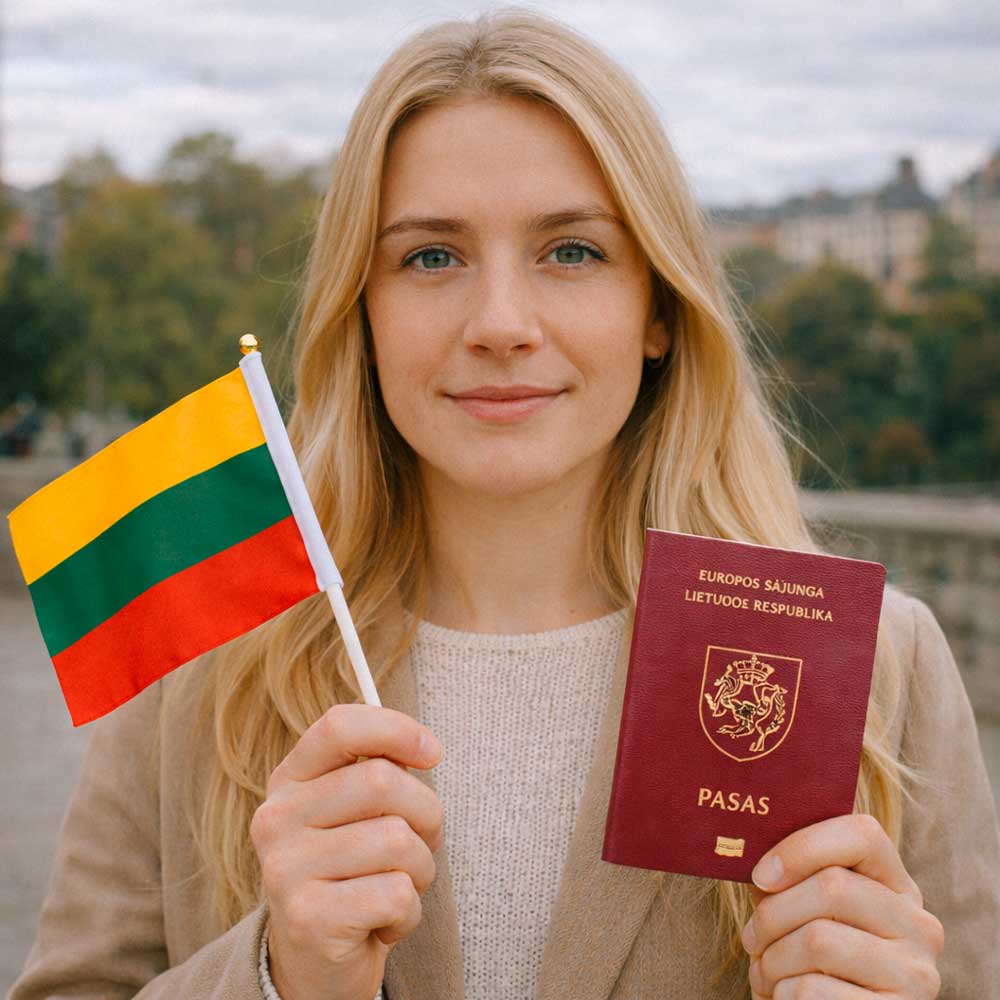
Yes, partially. The initial stage involves completing the application online through the MIGRIS system on the official website of the Migration Department. You register the form, attach scanned copies of your documents, and choose a date for your visit. However, it is not possible to obtain citizenship entirely online, you must still personally visit the migration office (or consulate) with the original documents and provide biometric data. In addition, the oath must also be taken in person.
Yes, you must pass an exam in the Lithuanian language and a test on the fundamentals of the Constitution (state system) of Lithuania. There is no separate history exam, but the Constitution test may include questions related to the state structure, including historical aspects (for example, dates of national holidays or key events in state formation). The required language level is basic, approximately A2, sufficient for everyday conversation. The exams are organized by the National Education Agency and are held regularly. Only persons over 65 years old, children under 14, and individuals with severe health limitations are exempt. All other applicants must confirm their knowledge of the language and basic laws.
No, there is no direct “citizenship by investment” program in Lithuania. You cannot simply invest money and immediately receive a passport, and it is not legally possible to buy citizenship. The closest option is that investment grants the right to obtain a residence permit, and only later, through standard naturalization after several years, can you obtain citizenship.
Currently, dual citizenship in Lithuania is permitted only in exceptional cases (by descent, for refugees, for persons with special merits, and in certain other situations). In 2024, a referendum was held to expand dual citizenship, but it did not reach the required turnout. Theoretically, changes are possible in the future, but this would require amendments to the Constitution.
Yes. A Lithuanian passport is the passport of an EU and Schengen Area country. It allows visa-free travel to approximately 170+ countries, free residence and employment in all EU member states, and access to the European banking system, education, and social protection. Lithuania is a member of the EU and NATO, which makes the Lithuanian passport stable and reliable in terms of international status.
Yes. Lithuanian citizenship by ancestry is possible if you are a descendant of Lithuanian citizens (for example, if your parents, grandparents, or great-grandparents were citizens of the country before 1940 or were deported). In such cases, a simplified citizenship restoration procedure applies, and in many situations it is permitted to retain your original citizenship. The key requirement is to provide documentary proof of your origin.