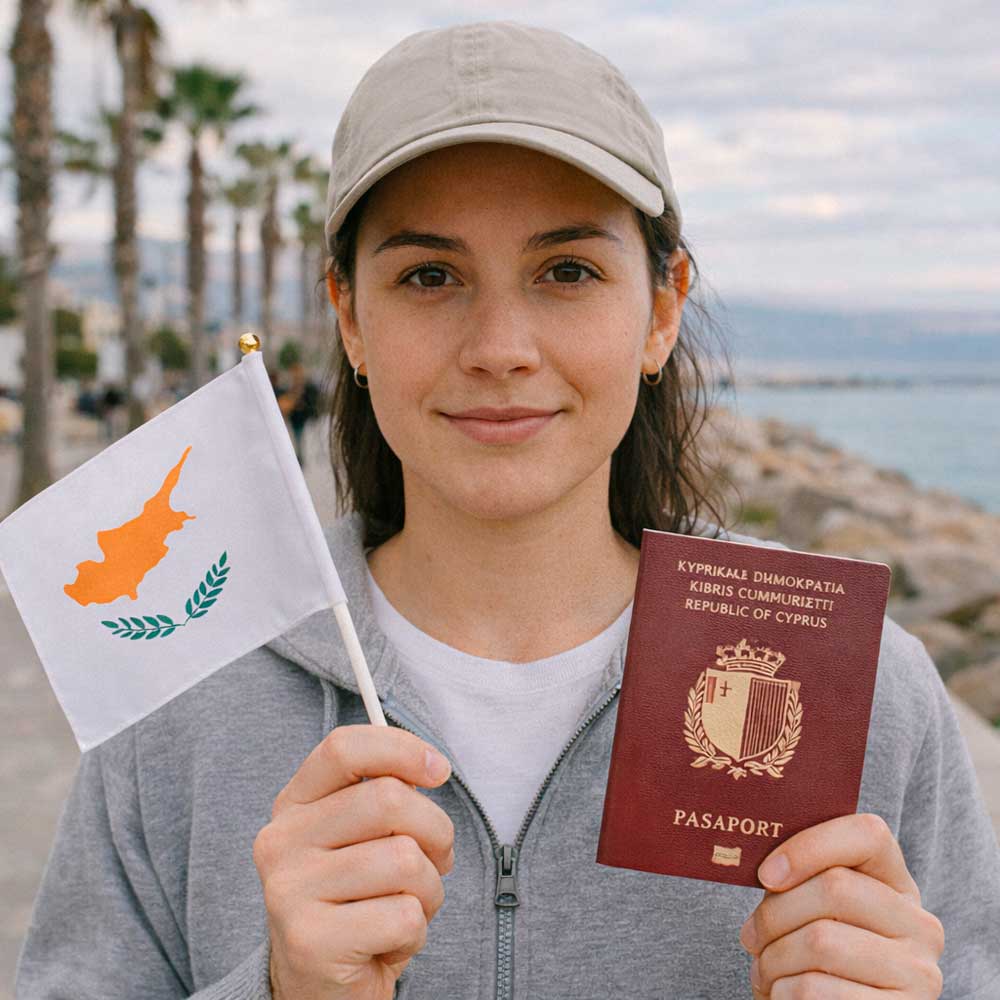
Cypriot citizenship is highly valued due to the country’s status as a member of the European Union. A holder of a Cypriot passport becomes a citizen of the EU and therefore gains the right to freely live, work, and study in any EU country. Unlike temporary or permanent residence permits, citizenship of the Republic of Cyprus provides a lifelong status without renewal requirements, political rights (such as voting in elections), and the ability to pass the status on to children. For many immigrants, a Cypriot passport is a “safe haven” and a second citizenship that broadens opportunities.
Who might be interested in Cypriot citizenship? Practically anyone who plans to link their life long-term with Cyprus or Europe. Businesspeople gain access to the European market and a favourable tax regime (the corporate tax rate in Cyprus is 12.5%, one of the lowest in the EU). Families value safety, environmental quality, and high-standard healthcare: registered residents and citizens of Cyprus have access to the universal healthcare system GESY. Students and young professionals receive a European diploma and the right to work without restrictions. In addition, a Cypriot passport means freedom of travel: visa-free entry to more than 160 countries worldwide, including the Schengen Area, the United Kingdom, Japan, and others. It is no coincidence that citizenship of this island state often appears in reviews as one of the most desirable second citizenships among immigrants.
It is important to understand the difference between citizenship and mere immigration status in Cyprus. A residence permit (temporary or permanent) allows living in the country but does not grant all the rights of a citizen and, as a rule, is valid only within Cyprus. For example, permanent residence through investment allows living on the island, but travel within the EU still requires a visa or status in another country. Cypriot citizenship, on the other hand, automatically makes you a full EU citizen: you can freely move from country to country, work without special permits, and receive consular protection from any EU state outside the Union.
In this article, we will examine why a Cypriot citizen’s passport is needed, what grounds and methods exist for obtaining it, how much time the process takes, what requirements apply to applicants, and what to pay attention to in 2026.
Advantages of Cypriot citizenship
- Freedom of travel. A Cypriot passport grants visa-free access to more than 170 countries, including all EU member states, the United Kingdom, Canada, Japan, Australia (with an electronic visa), and many others. For comparison, by 2020 Cypriot citizens could travel freely to 174 countries worldwide. After Cyprus’s planned accession to the Schengen Area (expected in 2026), travel around Europe will become even more convenient.
- The right to live and work in the EU. By obtaining a Cypriot passport, you are entitled to live in any of the 27 EU countries without time restrictions. You can openly seek employment or conduct business in Europe without additional permits. For families, this means that children will be able to enroll in universities in any European country as EU citizens—often on preferential terms and with lower competition.
- Social guarantees and healthcare. Cypriot citizenship provides access to social security and healthcare systems. Residents and citizens registered in the social insurance system receive free medical care in public hospitals. In addition, a Cypriot citizen receives the European Health Insurance Card (EHIC), which allows access to emergency medical care in other European countries. Social benefits, pensions, and other allowances in Cyprus become available to you on the same basis as to other Cypriots.
- Transfer of citizenship to children. The status of a Cypriot citizen is passed on by blood to children and descendants. A child born to a Cypriot parent automatically receives citizenship, regardless of whether the birth takes place in Cyprus or abroad. Even if you yourself obtained a Cypriot passport through naturalization or investment, your children and grandchildren will be able to become citizens by origin. This is a significant advantage for those planning to settle in a new country with a long-term perspective for future generations.
- Possibility of dual citizenship. Dual citizenship is permitted in Cyprus. The country does not require applicants to renounce their previous citizenship upon naturalization. You may hold a Cypriot passport while retaining your original one (provided that the legislation of your home country allows this). However, it is important to take into account the laws of your country of origin, as some states do not officially recognize dual citizenship.
- “Safe haven” and security. A second passport provides protection in times of crisis. A holder of a Cypriot passport can always enter Cyprus, even if borders are closed to foreigners (as happened during the pandemic). Cyprus is a country with a high standard of living and security: in the Numbeo Quality of Life Index 2024, Cyprus ranks 36th, ahead of countries such as Italy and South Korea. For families, this means a stable environment, low crime rates, and an ecologically clean setting.
- Financial and business opportunities. A Cypriot citizen can freely open bank accounts in any EU country and obtain loans and mortgages on favorable terms. Citizens often have access to higher credit limits: for example, in Cyprus a foreigner with a residence permit may obtain a loan of up to €500,000, while a citizen may receive up to €1,000,000. Citizenship also simplifies doing business: it is possible to open a company in Cyprus or relocate a business to the EU without excessive bureaucracy. A favorable corporate tax rate of 12.5% makes Cyprus attractive to entrepreneurs.
Taken together, a Cypriot citizen’s passport grants a status that opens up the entire European Union, high standards of living, state protection, and new horizons for travel and work. It is no coincidence that reviews from immigrants who have already gone through this path emphasize that the effort required to obtain Cypriot citizenship is well worth it.
Get a free consultation on the Cypriot citizenship application process
Fill in the short form below and a Mycitizenagency specialist will contact you as soon as possible
Who is eligible to apply for Cypriot citizenship
The Cypriot Citizenship Law provides for several categories of persons who have the right to apply for naturalization or registration as a citizen of Cyprus.
- Persons born into Cypriot families (by origin). If at least one of the child’s parents is a Cypriot citizen, the child automatically acquires citizenship by right of blood at birth. This also applies to children born abroad (although in certain cases, for example for those born before 2000 to a Cypriot mother outside Cyprus, formal registration is required). Thus, direct descendants of Cypriots may apply for citizenship based on kinship. A related case is the repatriation of descendants: a person whose parents or grandparents were Cypriot citizens may apply for citizenship by providing documents confirming family ties. Even if the applicant was born outside Cyprus and has never lived there, Cypriot citizenship by repatriation is possible upon confirmation of ancestry.
- Foreigners who have lived in Cyprus for a long time (naturalization). Most immigrants obtain a Cypriot passport through naturalization, that is, after many years of lawful residence on the island. Naturalization is available to adult foreigners who have lived in the country for the required period and have met other integration conditions. As a rule, at least 7 years of residence are required, with the final year spent continuously in Cyprus. Once the residence requirement is met, an application for citizenship may be submitted. Reduced preferential timeframes exist for certain applicants. For example, parents of Cypriot citizens may apply after 5 years of residence (this rule applies to foreigners whose children have obtained a Cypriot passport). Since 2023, relaxations have been introduced for highly qualified specialists: employees of innovative companies may obtain citizenship under an accelerated procedure after 5 or even 4 years of residence, provided that specific criteria are met (for example, language proficiency at level A2 and employment in a government-approved sector). However, these cases are exceptions; under the general rule, an applicant for naturalization must reside in Cyprus for approximately 7–8 years.
- Spouses of Cypriot citizens (through marriage). If a foreign national is legally married to a citizen of Cyprus, he or she may also obtain citizenship. The condition is that the marriage must have lasted at least 3 years. If the family permanently resides in Cyprus, an application for citizenship may be submitted after just 2 years of joint residence on the island. In cases where the spouses live outside Cyprus, a full 3 years of marriage are usually required before applying. In all cases, immigration authorities verify the authenticity of the family relationship: cohabitation, the presence of common children, history of communication, financial interdependence, and so on (fictitious marriages are refused).
- Investors in the country’s economy. Previously, the “Cyprus citizenship by investment” program was widely promoted, allowing applicants to purchase a passport through significant investments. However, it is currently impossible to directly buy Cypriot citizenship: the investment citizenship program was officially closed in November 2020. Nevertheless, wealthy foreigners still have a path to a passport through investments, but it is a two-stage process. A financially capable applicant may invest in the Cypriot economy (for example, purchase real estate worth at least €300,000) and obtain Cypriot permanent residence through investment, the so-called “golden visa.” Holders of such investor permanent residence, together with their families, immediately become permanent residents of Cyprus, bypassing the temporary residence permit stage. After several years of residence (previously 5 years, now the conditions have aligned with the general rules—approximately 7–8 years), the investor may apply for citizenship through naturalization on general grounds. Thus, investments do not grant citizenship automatically, but they significantly facilitate immigration and allow one to become a citizen through naturalization. In 2026, this path remains relevant: for example, by purchasing new real estate for €300,000 and obtaining permanent residence, an investor may apply for a Cypriot passport after 7–8 years of residence.
- Special merits, refugees, and other cases. The law also provides for the possibility of honorary or award-based citizenship for special merits to the Republic. In very rare cases, the Council of Ministers of Cyprus may personally grant a passport to an outstanding foreigner—for example, a scientist, athlete, or investor who has made an exceptional contribution to the country’s development. These cases are discretionary and have no fixed eligibility criteria; all decisions are made individually at the government level. In addition, persons who have been granted asylum (refugees) and have lived in Cyprus for many years usually follow the path of naturalization on general grounds (time spent in refugee status may be partially counted). Birth on the territory of Cyprus alone does not grant citizenship to a child if the parents are foreigners. The principle of “right of soil” (jus soli) does not apply here, except in cases where the child would otherwise become stateless. Therefore, the common idea of “going to Cyprus to give birth in order to obtain a passport for the child” does not work—citizenship is based on origin, not place of birth.
Thus, the range of eligible applicants is quite broad: from children of Cypriots to immigrants who have established roots on the island, from foreigners married to Cypriots to investors and rare individuals with special merits. Practically anyone who has lawful grounds—marriage, years of residence, family ties, or investments—may eventually apply for Cypriot citizenship, provided that the requirements are met.

Ways to obtain Cypriot citizenship
Now let us examine the main ways to obtain Cypriot citizenship in more detail and go step by step through each option.
By birth (right of blood)
The most direct path is to be born into citizenship. A child whose mother or father is a Cypriot citizen automatically becomes a citizen (it is only necessary to register the birth certificate and the child’s citizenship). If both parents are foreigners, birth on the territory of Cyprus does not grant citizenship. In this case, the child acquires the citizenship of the parents. An exception is made only in extremely rare situations where the child has no citizenship at all (for example, when the parents are stateless persons).
By origin (repatriation of descendants)
This category includes obtaining citizenship based on Cypriot roots. If you were born outside Cyprus but one of your parents is a Cypriot citizen, you are entitled to citizenship by origin. The procedure is called registration of citizenship: it is necessary to provide documents confirming the chain of kinship (birth and marriage certificates of your parents/ancestors, identification documents of the Cypriot parent, and so on).
In some cases, it is possible to obtain citizenship even through a grandmother or grandfather if they were Cypriot citizens, although this is more complicated: it is necessary to prove that your parent had the right to citizenship through them but did not formalize it, and then register two successive transfers of citizenship by descent. Residence in Cyprus is not required in this case—the key factor is proof of family ties. The processing time for such applications is usually shorter than for naturalization (from approximately 6 months to one year or slightly longer, depending on the completeness of the documents).
However, a large number of documents will be required; sometimes archival records, apostilles, translations, confirmation of name changes, and other materials are necessary. Immigration lawyers note that the key to success on this path is assembling a complete set of certificates so that there are no “gaps” between generations. If certain civil status records are missing, they will have to be restored through archives or replaced with notarized witness statements.
Naturalization (through residence)
This is the acquisition of Cypriot citizenship through long-term lawful residence on the island. The residence requirements as of 2026 are as follows: as a rule, it is necessary to reside for at least 7 years (2,555 days) within the last 10 years in resident status. In addition, immediately before submitting the application, it is necessary to spend 12 consecutive months in Cyprus (short trips abroad of up to 90 days in total are permitted). These rules constitute the general basis. Reduced naturalization periods are possible for certain categories:
Foreigners who have children who are Cypriot citizens (either minor or adult children). For parents of Cypriot citizens, the residence requirement is reduced to 5 years.
Accelerated naturalization for highly qualified specialists: if you work for a high-tech company registered in Cyprus and have knowledge of Greek at least at level A2, you may apply for citizenship after 5 years of residence (or 4 years if all criteria are met). This “pilot” preferential regime was introduced recently to attract talent and may be expanded by 2026.
When applying for naturalization, it is important that all years of residence were lawful, with continuous maintenance of temporary or permanent residence status. Periods of absence exceeding a certain threshold (usually more than three consecutive months) may “reset” the residence count. Years spent in Cyprus on a student visa or in asylum-seeker status are not counted toward the residence requirement. Thus, the type of residence permit held is also significant.
Once the residence requirements are met, the procedure itself begins: collecting documents confirming residence, integration, income, and so on (the process is described in the next section). Overall, naturalization is the longest path (taking many years of one’s life), but it is accessible to virtually anyone who has genuinely relocated their life to Cyprus and wishes to ultimately become a citizen.
Citizenship through marriage
A spouse of a Cypriot citizen may obtain citizenship under a simplified procedure. The condition is that the marriage must have lasted at least three years and that the couple is genuinely married. If the family has lived in Cyprus for all three years, an application may be submitted after just two years of joint residence on the island (while the marriage itself must still last a minimum of three years).
If the spouses live abroad, it is necessary to demonstrate a longer official duration of the marriage—generally three years—and, most likely, at least periodic joint visits to Cyprus to confirm a connection with the country. An application through marriage must include documents such as a marriage certificate, a copy of the Cypriot spouse’s passport, and evidence of joint life (shared rental or property, joint bills, photographs, correspondence, and so on).
Authorities may request additional evidence if there are doubts about the authenticity of the relationship. The procedure takes approximately 1–1.5 years after submission of documents. It should be borne in mind that fictitious marriages are prosecuted—if deception is detected, the applicant faces refusal and even deportation. Genuine families integrated into Cypriot society generally complete this procedure successfully.
Investments (through investor permanent residence)
As mentioned, there is no longer a direct program to “buy Cypriot citizenship.” Instead, there is a permanent residency by investment program (Permanent Residency by Investment), in operation since 2014. A foreigner who invests at least €300,000 in the Cypriot economy (residential property, commercial real estate, shares in Cypriot companies, or funds) and has a legal annual income of at least €50,000 (plus €15,000 for a spouse and €10,000 for each child) may obtain Cypriot permanent residence through an accelerated procedure (within a few months).
Under this program, the applicant’s spouse, children under 18, and financially dependent student children up to 25 years old may join. After obtaining investor permanent residence, the family must maintain the investment (for example, not sell the purchased property) and remain law-abiding. After 7 years of residence (previously 5 years, but recent amendments have tightened the requirements), the holder of the “golden visa” may apply for citizenship through naturalization.
This makes the investment route the fastest after marriage and origin. However, it is also the most expensive: the cost of Cypriot citizenship through investment is effectively equal to the amount invested. For example, by investing the minimum €300,000 in housing, taking into account taxes (19% VAT when purchasing new property), fees, and services, the total expenses for a family may exceed €360,000–€400,000. These funds are not a payment to the state for a passport (as was the case under the former CIP program), but without such capital investments, the investment route is impossible.
Special merits and exceptions
In certain cases, the government of Cyprus may grant citizenship by special decision—for example, for outstanding achievements in science, sports, culture, or a significant contribution to society. Such an honorary passport is extremely rare. The Council of Ministers may individually exempt a candidate from formal requirements (such as the residence period) and naturalize them more quickly. There are also known cases in which prominent foreign investors received citizenship outside the standard program, by way of exception (before the 2020 scandal, such decisions were sometimes made). Ordinary immigrants should not rely on this path—it is unpredictable and applied solely at the discretion of the authorities.
Thus, the appropriate method depends on your situation: those born into Cypriot families register by origin; those who have lived for many years apply through naturalization; spouses apply through marriage; investors through permanent residence; and descendants through repatriation. Choose the basis that suits you best and move on to the next step—the application procedure.

Find out how to obtain citizenship faster
Procedure for obtaining Cypriot citizenship
Obtaining citizenship is a step-by-step process that requires preparation. Let us go through, step by step, how to obtain Cypriot citizenship in practice:
- Checking the grounds and timeframes. First, make sure that you meet the criteria for your chosen option. Check your period of residence: how many years you have legally lived in Cyprus (and whether this period was interrupted by long absences). If you are applying through marriage, consider whether enough time has passed since the wedding date and whether you and your spouse lived in the same territory. For origin, check whether proof of kinship has been collected. Make sure that you have met the minimum residence period: for example, for naturalization it is 7 years (and in fact 7 years plus the final year without leaving). For an investor, the existence of permanent residence and also a sufficient period on the island are required. If something is missing (years of residence, a document confirming kinship, etc.), it is better to fill this gap in advance than to receive a refusal.
- Collecting documents. This is one of the most labor-intensive stages. The standard set of documents includes: a valid international passport, a document confirming your current resident status (temporary/permanent residence permit), the applicant’s birth certificate, a marriage certificate (if applicable), criminal record certificates from Cyprus and the country of origin, and documentary proof of your residence history in Cyprus (for example, copies of all previously issued residence permits, passport stamps). If there is a special basis, additional documents are required: for marriage—marriage certificate and evidence of family life; for origin—birth certificates of the Cypriot parent and documents linking each generation; for investor permanent residence—documents on the investment, income, and the permanent residence certificate itself. All foreign documents must be certified and legalized (apostille) and translated into Greek or English. Pay attention to the validity periods of certain certificates: for example, a criminal record certificate is usually valid for 3–6 months, so it should be obtained closer to the submission date. A common mistake is submitting expired certificates or uncertified copies, which leads to prolonged requests for additional documents.
- Submitting the application. The completed dossier is submitted to the Civil Registry & Migration Department (CRMD) under the Ministry of Interior of Cyprus. If you are outside Cyprus, you may submit documents through the consulate of the Republic of Cyprus in your country. Fill out the official application form (Application for Naturalisation or another form relevant to your case) and attach all required documents. Online submission for citizenship is not yet available—original documents and the applicant’s personal signature are required, so everything is done during a personal visit or through an authorised representative/consulate. A state fee is paid upon submission: usually several hundred euros. For example, as of 2025 the basic fee for naturalisation was about €500 (in complex cases, separate charges may apply for the certificate of naturalisation, stamps, registration fees—totalling around €1,000). For spouses of Cypriot citizens, the fee is slightly lower (around €300–€500), while registration by birth is symbolic (€20–€50). It is better to clarify exact amounts immediately before submission, as they may change.
- Integration: interview or exam. After your dossier is accepted, the authorities may schedule an interview or tests, especially if you are applying through naturalisation. Recently (since the end of 2023), Cyprus has introduced exams on knowledge of the language and the fundamentals of life in the country for future citizens. Naturalisation applicants must confirm knowledge of Greek at a level not lower than B1 (free communication in everyday situations). For some categories, A2 (basic) level is allowed—for example, highly qualified specialists applying under the accelerated route may have A2, but then the minimum residence period is 5 years. The language test is conducted by the Ministry of Education: it is a written exam organised approximately once a year. In addition to the language, applicants are now tested on knowledge of key aspects of Cyprus’s political and social structure—something like a test on Cyprus history and civics. The exam includes 24 questions: in half of them you must choose the correct option, and in the other half you must answer “true/false.” A minimum of 60% correct answers is considered a pass. For preparation, materials from the official tourist portal and the Ministry of Education website are recommended. If the exam is not passed, the chances of naturalisation drop sharply. For those who do not know Greek at all, it makes sense to take language courses in advance. For spouses of citizens and other categories, such an exam may not be required (for example, language is not checked for registration by origin). However, in any case, migration officers have the right to conduct an interview with the applicant. The purpose is to confirm identity, biographical data, and ask questions related to the application. In the case of an application through marriage, both spouses may be present at such an interview—they may be asked about details of family life to ensure that the marriage is not fictitious. If you submitted documents through a consulate, you may be called for an interview in Cyprus, or it may be held at the consulate/by video call. It is important to answer honestly and confidently, show respect for the country, and demonstrate knowledge of at least basic things (for example, who the president is, what the state symbols are, the language, holidays—basic awareness is welcomed).
- Waiting for a decision. Consideration of a citizenship application in Cyprus takes from several months to several years. Officially, the minimum processing time is about 12 months, but in practice it is often longer. Naturalisation is usually considered for approximately 1–2 years (12–24 months), and in complex cases up to 3 years. Applications through marriage may be somewhat faster (around 1 year), while applications by origin are also around a year, sometimes less with a complete set of documents. In any case, you will need patience. Many aspects are checked: your documents undergo verification, due diligence requests are made (including checks in Interpol and Europol databases for the absence of convictions and sanctions), and financial capacity and integration are assessed. If something is missing, you may receive a request for additional information. Therefore, it is important to provide up-to-date contacts and respond to department requests in a timely manner so as not to delay the process even further.
- Receiving the decision and taking the oath. You will be notified of the result officially. If approved, you will receive a letter with an invitation to complete the procedure. Usually, it is necessary to take an oath of allegiance to the Republic of Cyprus before an authorised official or judge. The oath text confirms that you undertake to comply with the laws of Cyprus and are loyal to the country. After taking the oath, you are issued a Certificate of Naturalisation—a document confirming that you have become a citizen. Then, on the basis of this certificate, you can apply for a Cypriot citizen’s passport and an internal identity card (ID card). The passport is issued within approximately 10 days (there is an accelerated option in 2 days for an increased fee). The first passport is issued for 10 years (for children—for 5 years). At this point the process is complete—you are a full-fledged citizen.
- Refusal: what to do? If, for some reason, a refusal is issued, it is not the end. The decision can be appealed in the Administrative Court of Cyprus within 75 days. In the appeal, it is necessary to prove that the refusal was unlawful. However, it is better not to reach a refusal: prepare the documents carefully from the very beginning. Common reasons for refusal include providing inaccurate information, an incomplete set of documents, serious legal problems of the applicant, violations of the immigration regime, or a lack of integration. After rectifying the reasons, you can try to apply again after some time.
Thus, the path to citizenship consists of a clear sequence of actions: assessing your grounds — collecting evidence — submitting the application — undergoing checks — waiting — taking the oath. If you prepare in advance and approach each stage responsibly, the process will go as smoothly as possible.
Do you want to find out whether you can obtain Cypriot citizenship? Leave a request for a consultation — we will analyse your eligibility and timelines and help you choose the best legal option for obtaining second citizenship, taking into account your goals and plans for 2026.
Requirements for applicants
To obtain Cypriot citizenship, it is not enough to live in the country for the required number of years—it is also necessary to meet other requirements of the Cypriot Citizenship Law. Below are the key conditions to which the authorities pay attention when reviewing applications:
- Long-term residence. Continuous lawful residence on the territory of Cyprus for the prescribed period is required. For most applicants, this means 7 years of residence (a minimum of 2,555 days in total over the last 10 years), plus the final year spent continuously in the country. Short-term absences are permitted (up to 90 days during the final year). If you were absent for longer, the continuity of residence is interrupted. There are exceptions, as mentioned above: 5 years of residence for parents of Cypriot citizens, 3–5 years for certain specialists, and 2–3 years for spouses of Cypriot citizens. However, in general, seven years is the basic residence requirement. Periods of study or asylum are not included—only residence under permits that grant the right to long-term stay (employment, business, family, investment, and so on). Residence permit statuses must be kept valid; if there was a break and the permit expired, the residence period may be reset.
- Law-abiding conduct and good reputation. An applicant for citizenship must have a clean criminal record. Criminal convictions are checked both in Cyprus and in other countries. Serious crimes, especially in recent years, almost certainly lead to refusal. There must be no unresolved criminal cases or investigations either in the country of origin or in the Republic of Cyprus. You must also not pose a threat to national security or public order. Connections with undesirable organisations are assessed critically—for example, participation in extremist groups, links to individuals under EU sanctions, or support for illegal regimes (in the Cypriot context, this includes, for example, cooperation with the authorities of the unrecognised Northern Cyprus). Even public statements against the Republic may be harmful—social media is now checked for signs of disloyalty. In short, the candidate must demonstrate loyalty and good character. In addition, migration authorities examine immigration compliance: whether you violated conditions of stay, lived illegally even briefly, or have a history of deportations. A good character reference and the absence of legal issues are mandatory requirements.
- Integration into Cypriot society. Cyprus requires new citizens to be integrated into the country to a certain extent. In practice, this is expressed in two aspects: language proficiency and knowledge of life in the country. As already stated, the officially required level of Greek language proficiency is currently no lower than B1 according to the Common European Framework. This must be confirmed by a certificate (after passing an exam) or another document. For some applicants following preferential routes, level A2 is permitted, although aiming for a higher level is advisable. In addition to language, the presence of genuine ties to Cyprus is assessed: whether you have worked or conducted business, participated in local life, have family members or friends who are Cypriots, or attended local courses and events. When reviewing naturalisation applications, proof of integration is now required—for example, certificates of education, recommendations from local communities, participation in charitable activities, or at least long-term actual residence at a single address. Minimal ties to Cyprus despite long-term residence may result in additional questions or refusal. A new requirement is an exam on the fundamentals of the history, culture, and political structure of Cyprus (similar to a citizenship test), conducted twice a year. Its purpose is to ensure that you are familiar with the life of the country and share its basic values. By 2026, this exam will become a standard part of the procedure. Overall, it is important to demonstrate that you are integrated: you speak the local language at least at a basic everyday level, know the traditions and laws, and are ready to fulfill civic duties.
- Financial self-sufficiency. Applicants are expected to be able to support themselves and not become a burden on the state. The specific requirement is a stable legal income and/or employment. Recent changes have introduced a benchmark income of at least €2,500 per month for a single applicant (approximately €30,000 per year), plus additional funds for family members. This income may come from employment, business, or other legal sources (such as pension payments or dividends). If a candidate has not been officially employed for a long time, has received social benefits, or has outstanding debts, this may raise concerns. Intent is also taken into account: whether you plan to continue living in Cyprus or leave immediately after obtaining a passport. Although there is no direct requirement to continue residing in the country after acquiring citizenship, a clear lack of economic ties to Cyprus may concern the reviewing committee. It is recommended to attach evidence of financial capacity to the application: bank statements, property documents, an employment confirmation letter, and tax returns. It is also important to have no outstanding tax debts, fines, or loan obligations in Cyprus.
- Renunciation of previous citizenship is not required. Cyprus allows multiple citizenship, so you do not need to renounce your current citizenship when naturalising. The exception is if your home country requires it. In such cases, the choice remains yours: for example, a citizen of a country that prohibits dual citizenship must either renounce it or not obtain Cypriot citizenship. From the perspective of Cypriot law, no declaration of renunciation is required. You may even use both passports, although in certain circumstances (for example, holding public office in your country of origin) restrictions may apply. Please note that upon acquiring a new citizenship, Russian citizens are required to notify the Russian Ministry of Internal Affairs of their second citizenship within 60 days, otherwise a fine may be imposed. Other countries may have their own rules—check the relevant legislation.
- Age and legal capacity. Only an adult (18 years or older) and legally competent person may apply for naturalisation. Children do not submit applications on their own—their citizenship is obtained either automatically at birth from a citizen parent or together with their parents. For example, when a parent is naturalised, minor children may obtain citizenship simultaneously through registration by submitting separate child application forms. However, the principal applicant is always an adult. Advanced age in itself is not an obstacle if health and legal capacity are in order.
Thus, the conditions for obtaining Cypriot citizenship can be summarised as follows: you have lived lawfully on the island for a sufficiently long period, have integrated (learned the language and culture), have not violated the law, and are financially independent. If all these requirements are met, your chances of a positive decision are very high. Otherwise, it is advisable to strengthen weak points—for example, improve language skills or wait an additional year to ensure full continuity of residence—before submitting an application.

Timeframes and costs
How long does it take to obtain Cypriot citizenship and how much does it cost? Let us examine the timeframes and the main categories of expenses associated with the application process.
Minimum residence period before applying. For most applicants, the main “time driver” is the required residence qualification period. It amounts to 7 years (or 5 years for certain preferential cases, 3 years for spouses). That is, from the moment of obtaining the first residence permit until the possibility of applying for a Cypriot passport, at least 7 years usually pass. Investors are somewhat more fortunate: having permanent residence by investment, they previously could apply after 5 years; however, recent changes appear to have unified the period to 7 years for them as well.
In practice, many immigrants take longer to reach citizenship, especially if there were interruptions or changes in status. Through marriage, the timeframes are shorter—it is possible to qualify within 2–3 years of marriage. By origin, there are no residence requirements at all, so once the documents are collected, an application can be submitted immediately (even one month after a child’s birth, if the parent is a Cypriot citizen). Each pathway also involves its own preparation time: for example, naturalisation requires 7 years of residence, and during this period residence permits must be renewed annually or every few years, which is also time-consuming.
Application processing time. After submission, you enter the waiting period for a decision. Based on recent years’ experience, processing times are as follows: naturalisation—on average from 12 to 24 months. In some cases, applications take longer due to background checks or applicant backlogs (there were particularly significant delays in 2020–2021 after the closure of the CIP, when additional checks were introduced). Through marriage—approximately 12–18 months. By origin—from 6 months to one year, depending on the department’s workload and the complexity of your family tree.
If additional documents are required, the timeline may be extended. In any case, be prepared that a passport will not be issued quickly: even under simplified grounds, the process usually takes no less than six months. Many people ask whether it is possible to speed things up for an additional fee—no, officially there is no “paid acceleration” for obtaining citizenship (unlike the expedited issuance of an already approved passport within two days). All candidates wait in the order of the queue. The only exception may be cases of special merits, which are considered individually and quickly by government decision.
State fees and administrative charges. The cost of obtaining Cypriot citizenship is relatively low compared to its value. As of the end of 2025, state fees were approximately as follows:
- €500 — registration fee upon submission of a naturalisation application (including the cost of the application form and processing).
- Approximately €300–€400 — fee for submitting an application by a spouse of a Cypriot citizen.
- €20–€50 — symbolic fees for registration of citizenship by origin or by birth (for a child).
- €5 — stamp duty for each submitted application (for example, stamp fees of €8.54 per stamp, two stamps, as previously indicated for naturalisation).
- Approximately €70 — for issuance of the biometric passport after approval.
- Approximately €45 — for issuance of the ID card (internal identity document).
The amounts may change, but overall the cost of Cypriot citizenship in terms of government services usually falls within the range of €500–€1,000 per person (excluding intermediary services). If a family applies, some fees are multiplied by the number of applicants.
Translations and legalisation of documents. A significant category of expenses involves bringing your documents into compliance with requirements. Notarised translations into Greek or English of all documents are required (it is recommended to use licensed translators, especially for civil status records). Apostilles or consular legalisation are also required for all official documents issued abroad.
The cost of translations and apostilles depends on the country and the service provider: on average, an apostille costs about $20–30 per document, translation about $15–20 per page, plus notarisation of the translation. For example, if you have several certificates and statements, the total can easily amount to a few hundred euros for a complete document package. Take these expenses into account in advance so that you do not have to compromise on document quality—rejection due to incorrect translation will cost more in the long run.
Medical certificates and certificates of compliance. Applicants for residence permits often obtain medical certificates, insurance policies, and undergo medical tests. For citizenship, there are no specific medical requirements (except the absence of dangerous infectious diseases—if detected, this may become an obstacle). However, if you need to extend your resident status while waiting for a decision, you should also budget for these expenses (for example, medical examinations required for residence permit renewal).
Legal services and professional assistance. Although the law allows applicants to submit documents independently, many engage immigration consultants or lawyers for assistance — especially in complex cases (documentation chains by origin, overcoming refusals, preparation for exams). Professional assistance in obtaining Cypriot citizenship may cost from several thousand euros and upwards, depending on the scope of work and the firm’s reputation. For example, some law firms offer full-cycle naturalisation support for €2,000–€5,000 plus hourly fees for document collection. These expenses are not mandatory, but they can be helpful if you are concerned about making mistakes or lack the time to handle the process yourself.
Other expenses. You may need to travel to Cyprus several times (if you have not lived there continuously), for example, to submit documents in person or to attend the oath ceremony. Travel expenses should be taken into account. In summary, the price of Cypriot citizenship for an immigrant consists primarily of time (many years of residence) and effort, while direct financial costs of the application itself are relatively modest—hundreds of euros in state fees plus indirect expenses for translations, travel, and services. The most expensive route is the investment pathway, which requires investing hundreds of thousands of euros; however, these funds go into your property or business rather than being paid “for a passport.” For most categories, patience and effort are required more than large sums of money.
Check your chances of getting a passport in Cyprus free of charge
Leave a request for a free consultation with an immigration specialist at your convenient time
Is dual citizenship allowed?
Dual citizenship in Cyprus is a matter of concern for many applicants. The good news is that Cyprus allows dual and even multiple citizenship. When naturalising, you are not required to renounce your first passport. This is a major advantage compared to some countries that require applicants to give up their previous citizenship.
However, the key point is the legislation of your country of origin. You must make sure that it also allows holding a second passport. The situation varies by country. For example, almost all Western countries allow multiple citizenship. If you are a citizen of, say, Germany or Austria, there used to be restrictions, but in recent years Germany has been easing its policy, especially for EU citizens. In general, for people from the EU or North America, a Cypriot passport will simply become a second passport without bureaucratic issues at home.
The general position of Cyprus is that acquiring a second citizenship does not entail the loss of the first under Cypriot law. Moreover, if your children with Cypriot citizenship also hold the citizenship of another country, Cyprus does not prohibit this. Thus, you may hold Cypriot citizenship as a second citizenship and use both passports depending on the situation.
Possible risks primarily concern legal conflicts. For example, while staying in your country of origin, you are considered only its citizen, and the presence of a Cypriot passport may not help there (the Cypriot consulate will not be able to protect a Cypriot citizen if that person is simultaneously a citizen of that country—the principle of state sovereignty prohibits such intervention). There may also be difficulties with access to certain positions or security clearances in your home country if you hold a foreign passport. However, these nuances are individual.
Overall, for most immigrants the issue of dual citizenship is resolved positively: Cypriot citizenship and the original citizenship coexist peacefully. Many Cypriots themselves hold two or three citizenships (for example, children of Cypriot emigrants born in the United Kingdom). When applying for naturalisation, no certificates of renunciation are required. Simply familiarise yourself in advance with the laws of your country in order to comply with any possible formalities and avoid unpleasant situations.
Obtaining Cypriot citizenship is a real opportunity to open the doors to a European future for yourself and your family. A holder of a Cypriot passport benefits in many respects: travelling freely without visas, living and working in any EU country, enjoying social protection, and passing this status on to children. Cypriot citizenship is especially attractive for those who value stability, security, and quality of life, as it effectively provides a “safe haven” in a calm European country.
Of course, the path to an EU passport is not instantaneous. The main difficulties along the way are long waiting periods (years of residence followed by years of processing) and the need for careful document preparation. Many people make mistakes: failing to maintain continuity of status, not apostilling certificates, forgetting to renew criminal record certificates, or providing weak evidence of ties to Cyprus. These mistakes lead to refusals or delays. To avoid them, it is important to comply with the requirements as accurately as possible. At the document preparation stage, it is worth double-checking everything: whether all dates and names match, whether all forms are filled out correctly, and whether there are any expired documents. If there are doubts, it is better to consult an expert.
Practice shows that the most common reason for failure is the human factor: either the applicant rushed to submit without meeting the conditions (did not complete the required residence period, did not learn the language), or provided incomplete information. For example, a “forgotten” conviction from ten years ago or an error in a grandmother’s surname may surface and cause problems. Therefore, our advice is to start with an analysis of your grounds. Assess soberly whether you meet the criteria. If not, plan how and when you will be able to meet them (for example, extend your residence permit, pass the language exam, collect missing certificates). It may make sense to consult an immigration lawyer who will review your documents and advise on how best to substantiate the application.
Remember that every application is recorded in your history—it is better to do everything correctly from the start than to fight a refusal later. In 2026, the requirements have become stricter compared to previous years (exams have been introduced, more attention is paid to integration), so preparation plays a decisive role. At the same time, the value of the Cypriot passport remains high: the country listens to EU recommendations, makes the citizenship process more transparent and reliable, and therefore your future passport will be a respected document.
In conclusion, Cypriot citizenship is a goal that is achievable with sufficient perseverance. If you have truly linked your life with Cyprus, comply with the law, and integrate into society, you will in time become a full-fledged Cypriot. May this comprehensive guide help you understand all the nuances, avoid pitfalls, and confidently make the journey from a foreign resident to a proud holder of a Cypriot passport.
Frequently Asked Questions about Cypriot citizenship
We have compiled answers to the most common questions about obtaining Cypriot citizenship. If you did not find the information you were looking for or want to learn more about the requirements, timelines, and benefits of a Cypriot passport, contact us for a free consultation.
Main routes include:
- By birth or origin (if one of the parents is a Cypriot citizen);
- Through naturalisation—after 7 years of residence;
- Through marriage to a Cypriot citizen—from 2 years;
- Through investment (via permanent residence followed by naturalisation);
- For special merits (rare).
The Cypriot passport ranks among the TOP 20 “strongest” passports in the world. It provides visa-free access or visa on arrival to more than 170 countries, including the Schengen Area, the United Kingdom, Canada, Japan, and Australia. It is a full EU passport with high international recognition.
State fees range from €500 (naturalisation), from €300 (through marriage), and from €20 (by origin). Additional costs include translations, apostilles, and certificates. Total expenses generally range from €800 to €1,500. The investment route requires investments of €300,000 or more in real estate, but the passport itself is not for sale.
Not yet. The naturalisation procedure requires submission of original documents and handwritten signatures, therefore the application must be submitted either in person at the migration department in Cyprus or through a Cypriot embassy/consulate. You can download the forms online and prepare the documents, but the full package must be submitted physically. As of 2026, online submission systems for citizenship have not been implemented.
Yes, if you are obtaining citizenship through naturalisation (by residence). Since the end of 2023, exams have been introduced for candidates: knowledge of the Greek language at a level not lower than B1 and a basic understanding of the history, political system, and culture of Cyprus are required. The language and “civics” exam is conducted in Greek, usually once a year. At least 60% of the answers must be correct. If you already have a Greek language certificate, it will be taken into account. For spouses of Cypriot citizens and applicants by origin, the exam is generally not required. However, an oral interview in Greek may be conducted to assess your level.
There is currently no direct mechanism for purchasing citizenship—the “citizenship by investment” programme was closed in 2020. This means that investing money will not result in an automatic passport, as it did previously. The only indirect route for investors is to obtain permanent residence through investment (by investing at least €300,000 in real estate or business), then reside in Cyprus for the required number of years (currently 7 years) and apply for citizenship under the general procedure. The investment must be maintained until citizenship is granted.
A Cypriot passport grants all the rights of an EU citizen: the ability to live, work, and study in any European Union country, access to social welfare and healthcare systems, visa-free travel to more than 170 countries, and the right to pass citizenship on to children.